The Crazies of Politics

CraziesEach political party has their Crazies, those who possess worldviews wholly unconstrained by reality.  Crazies surface within all political parties and persuasions, and I’ve observed numerous examples.  I feel a strong urge to describe them, and I will do this in a non-partisan manner.

In the United States there are two dominant political parties: Democrats and Republicans. I’ll leave it to the historians and political scientists to lay out the origins and the evolution of these two political entities, but my focus in this post is on the Crazies.  First, some context.

Most registered voters in this country claim an association with either the Democrats or the Republicans. Depending upon which poll you believe, a growing number of registered voters refuse to identify their party affiliation.  Some of these people call themselves independents which means they prefer no party affiliation.  Relatively few people associate with one of the so-called minor political parties which ironically includes the Independent Party, among many others.  The varying voter registration practices in the states, territories, and in the District of Columbia cause some confusion regarding party affiliation.

In some states, like Florida, a voter is registered as either a Republican, a Democrat, as a member of one of the other minor parties, or as having no political party affiliation.  In these states, voters in primary elections only vote in their own party’s primary.  Registered voters affiliated with a party may switch parties prior to an election as long as this is done by an established deadline.

In other states, such as Illinois, voters register without designating any party affiliation, and they are free to vote in either party’s primary, and for any candidate they choose as long as they don’t vote on more than one ballot in each election.  In these states, voters don’t truly “belong” to a political party and it is difficult to assign them to one except by their own admission.  The political parties pay attention to who votes in each primary and target their membership and fund-raising activities based upon observed voting preferences.

The lack of a designated party affiliation creates chaotic outcomes in some primary elections where one party has a hotly contested race, but the other party does not. This often results in an advantage to incumbents who are not opposed in their own primary elections.  Their supporters are free to vote in the other party’s primary.  This allows potential mischief such as voting for and ultimately nominating the perceived weaker candidate of the opposition party.  But, this is an issue for another day.

Each party exploits the existence of the Crazies in the other party in order to demonize their opposition, asserting that the entire party is a bunch of Crazies of one type or another. It is my belief that most people and the vast majority of voters in each party are responsible citizens trying to elect the very best representatives to serve the people.  Nevertheless, the Crazies do exist.

As I’ve written before, I don’t particularly like labels that unfairly characterize entire groups of people. By admission, these are caricatures which by definition exaggerate certain qualities in order to make a point.  Nevertheless, I will undertake this excursion into political folly, and ask that you forgive me if what I present unfairly describes anyone you know.

Who Are These Crazies?

Low Information Voters – These are people who vote based upon an emotional attachment to a candidate, a party, or someone of influence over them.  They may be so busy or distracted in their own lives that they do not pay any attention to the issues or to any of the candidates.  They might be lazy, disinterested, or unmotivated.  Perhaps they are human lemmings following their own crowd unaware of the consequences.  “Whatever!”  “Who cares?”  “My mind is made up, don’t confuse me with the facts.”  They can vote for Republicans, Democrats, or anyone else since they are not constrained by any principles or ideology.  They vote based upon their feelings, or they vote the way they are told to vote, and then they go on with their lives.

Zealots – These voters may absorb and believe vast amounts of information about their particular candidates or parties, but they do not choose to evaluate it rationally or dispassionately.  Furthermore, what they believe or think they know about any opposition candidate or party is unencumbered by the facts.  They often demonstrate that dangerous combination of ignorance and arrogance.  Changing their minds is an impossibility, and they will likely demonize or attempt to silence anyone who dares to disagree with them.

Bigots – These people base their votes primarily upon the gender, nationality, ethnicity, religion, sexual orientation, or some other personal characteristics unrelated to the qualifications of candidates’ competence to serve in public office. They often deny their biases and project their prejudices onto those who oppose their favored candidates.

Crusaders – Some people focus almost exclusively on one issue or cause.  This manifests as a litmus test for discerning how to vote.  Such people decide how to vote based solely upon whether their cause is supported or likely to be advanced by a candidate or party.  All other issues are ignored or considered unimportant.  They are devoted exclusively to their cause.

Alarmists – These are people who have exaggerated fears driving their voting preferences.  They have irrational concerns that electing a particular candidate or party will have cataclysmic consequences for their area, state, the country, or indeed for the entire world.

Advocates – Some organizations pressure or influence their members to vote in a manner that is consistent with their special interests.  The members of the organization make voting decisions based upon a sense of responsibility or loyalty to the organization or to the industry the organization represents.

Extremists – these are people who will do anything to win an election. They will vote multiple times, alter ballots, steal ballots, duplicate ballots, and even stuff ballot boxes if they can get away with it.  They will threaten and intimidate others in order to achieve the ends which justify their means.  They demonize the opposition, they lie, cheat, steal, even murder if that will further their cause or their candidates.

In this exposé of political Crazies, I’ve been careful to avoid examples, but they are numerous and exist among both Republicans and Democrats, as well as in the other parties and among independents. The Crazies harm our country.  It is up to each of us to discipline ourselves so that we don’t end up being one of the Crazies.
Posted in Human Behavior, Politics | Tagged , , , | Leave a comment

How Would You Grade Our Schools?

How do you feel about the schools in your community?  How would you grade the nation’s schools?  How many of you would award your child’s school an A, B, or perhaps an F?

The Gallup organization has been polling Americans about their views of education for 45 years.  The results are published annually by Phi Delta Kappa International.  You might be surprised by the findings and the trends observed through the years since the first polls were conducted.

Before I go any further, let me remind us all that the published survey results represent the opinions of people in the sample population surveyed, and these opinions have very little to do with reality.  Just because a carefully selected sample of people thinks their schools are fantastic or rotten does not mean their schools are fantastic or rotten.  It only means that is what they report to pollsters.  In truth, most people have very little actual knowledge of the quality of the schools in their communities.  As for the effectiveness of our nation’s schools, we only know what we surmise from anecdotes we hear from friends, family, and people we know in our communities.  We also draw opinions from media reports that are often derived from press releases published by various organization, governmental and non-governmental.  These organizations almost always have an opinion driven agenda.

Some people may experience several schools in different parts of the country as they or family members move, but there are more than 133,000 schools in the United States.  Each school is a reflection of the community it serves and the state in which it operates. Each of these schools has a unique group of teachers educating a unique and diverse population of students. The students change every year and so do many of the teachers.

According to the National Center for Educational Statistics, 88 percent of the students in our country attend public schools, another 9 percent go to private schools, and the remainder, about 3 percent, are home schooled. According to the United States Census Bureau, the number of high school graduates among adults is at an all-time high. In only one century, the percentage of high school graduates in the adult population grew from around 10 percent to nearly 90 percent. The number of college graduates with at least a bachelor’s degree is also at an all-time high of approximately 30 percent. The average salary of those with at least a bachelor’s degrees is more than twice as high as those with only a high school diploma. Many highly skilled workers also enjoy high wages as a result of education and training not requiring a bachelor’s degree. In many states, the average salaries of those with associate degrees or technical certificates may be higher than those with only a bachelor’s degree, but both are significantly higher than those who went no further than high school. The unemployment rates for those with only a high school diploma are more than twice as high as those with college or technical degrees and certificates. The unemployment rate for individuals without high school diplomas is five times higher than those with a college or technical education. It pays to pursue education beyond high school in the United States.

By the time a person reaches the age of 18 and completes high school, he or she will have directly experienced at least 30 different teachers, coaches, club advisors, band directors, and counselors. An eighteen year-old would have spent more than 70 percent of their years attending school, or about 14,000 hours, more if they attended pre-school. On the other hand, high school graduates will have spent only about 11 percent of their lives in school. School is key to a person’s future, but other influences may be far more significant. What exerts the greatest influence on a child’s development depends upon the family, the community environment, peer pressure, and other socio-economic factors far beyond the control of schools and their teachers.

In the United States, there are world-class schools that out-perform schools anywhere in the world. Unfortunately, there are horrible schools as well with incompetent teachers and administrators, overseen by dysfunctional and even dangerous school boards. We have a tendency to describe schools and their effectiveness by averages, and therefore, we overlook the extremes of excellence and failure that exist. News reports tend to focus on the negatively sensational and that is often how we form our opinions.  The results of the Gallup Poll illustrate this very well.

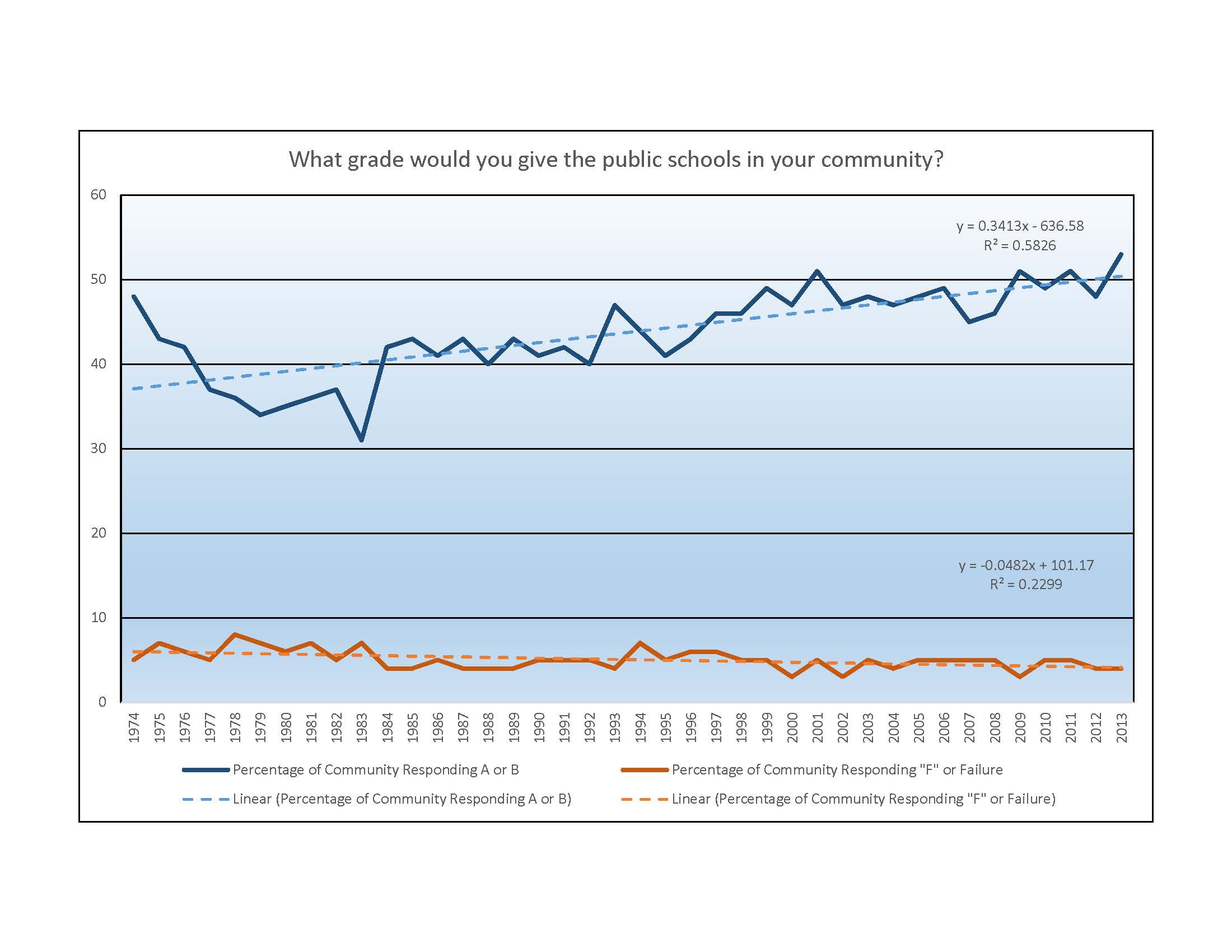
According to the most recent survey conducted by Gallup in 2013, about 53 percent of Americans would give the schools in their local communities a grade of A or B.  This is the highest percentage ever reported in the forty years that this question has been asked.  And the trend is up.  Now more than ever before, people give their local schools high marks.  At the same time, only 4 percent say the schools in their local communities deserve an F.  And this percentage  is declining.Public Schools in Your Community - PDK Gallup Poll Trends

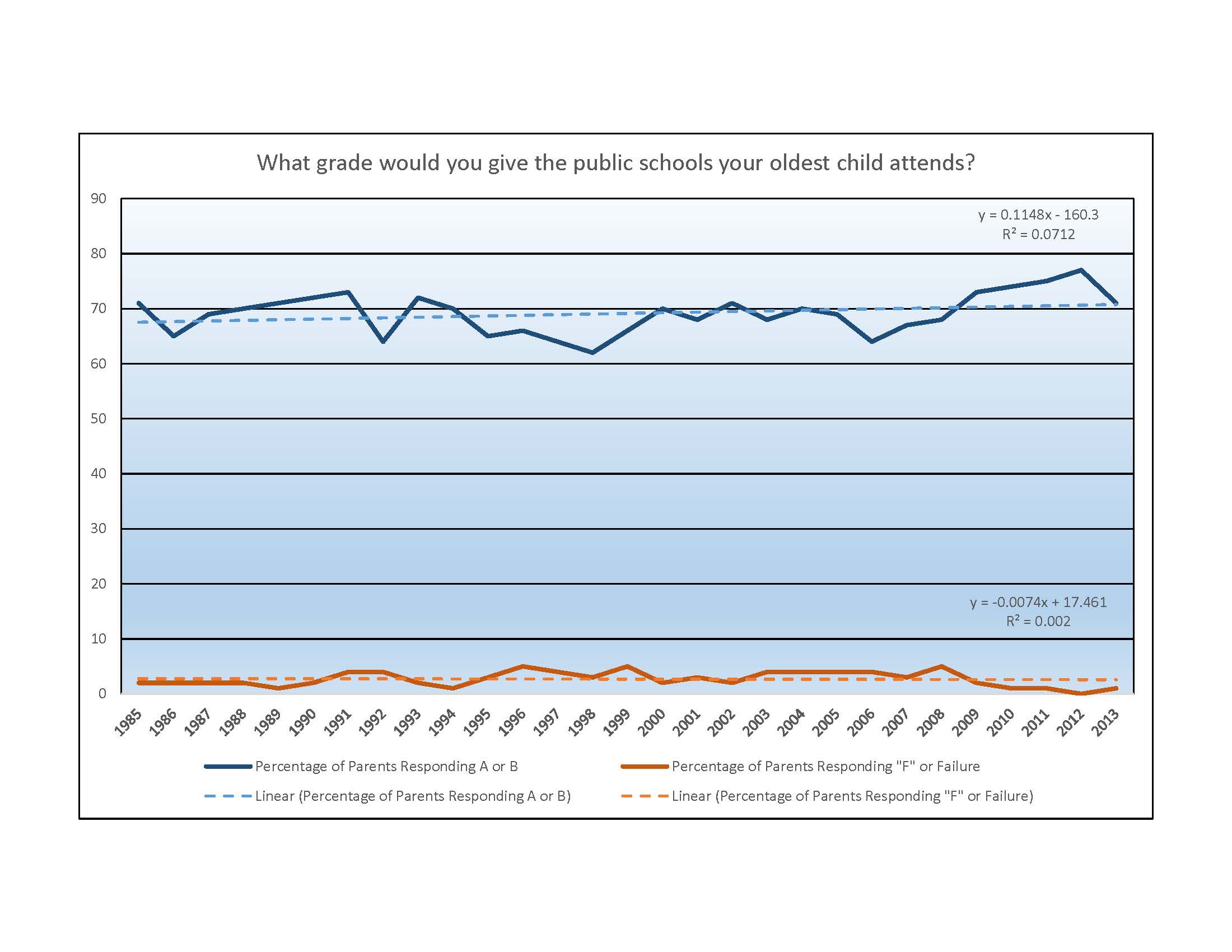
The above trend represents the opinions of everyone in the sample, whether they have children in the local schools or not.  The Gallup survey also asked parents the same question and the results are even more favorable.  This year 71 percent of respondents who were parents rated their oldest child’s schools as deserving an A or a B and only 1 percent gave their own schools an F.  For some reason, last year fully 77 percent of parents gave their child’s schools an A or B grade, and amazingly, zero percent assigned an F to their own child’s school.

Public Schools Your Child Attends - PDK Gallup Poll Trends

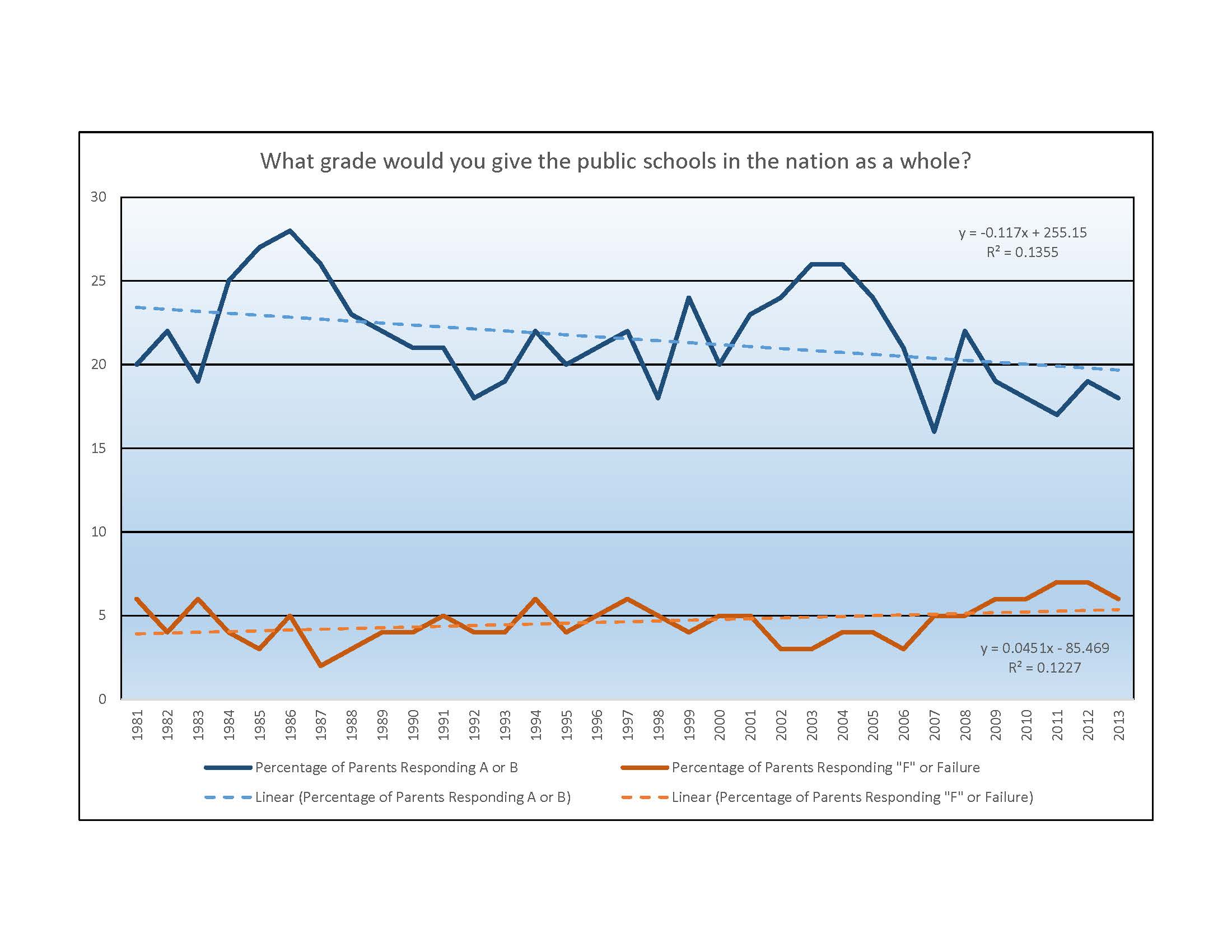
In stark contrast, in the opinion of those surveyed, the grades deserved by the nation’s schools are not nearly so high, and the trend is definitely downward.  Only 18 percent assign a grade of A or B, while 6 percent report that the nation’s schools are failing.  Most Americans rate the nation’s schools as deserving C or D grades.  This is not good news. Public Schools in the Nation - PDK Gallup Poll TrendsThese results are paradoxical.  The majority of Americans sampled consider their own schools to be good or excellent, but they do not consider the nation’s schools so favorably.  What is the truth?

The truth is hard to measure, and we are not measuring it in any scientific way.  Politicians have discovered that the alleged failure of our schools is another one of the those perpetual problems just waiting for them to solve.  To be sure, any institution such as our educational system can be improved.  And those involved, teachers, parents, school administrators, and our political leaders should endeavor to continuously pursue excellence.  Measuring effectiveness is necessary to monitor progress.

Political interventions are all too often not helpful, and perpetual problems don’t go away.  Local school boards should have the greatest responsibility for improving the effectiveness of their schools.  They are closest to the people they represent and can be held accountable when schools are not progressing.  Furthermore, with local control comes the possibility for innovation and experimentation.  Each school is a laboratory for understanding how to improve our schools.  States should ensure that funding is sufficient and equalized.  Every student in the state should have an equal opportunity for an excellent education.  The national government should have little responsibility for public education beyond funding special programs and initiatives not possible for the states or local communities to support on their own.

Posted in Education, Media, Politics | Tagged , , , , | Leave a comment

A Time for Reflection About Education

Clean Desk (3)Last summer, after 45 years in higher education, I retired.  It has been a little more than nine months since I turned in my master key and walked out of my office for the last time.   It was time to move on, and I’ve adjusted well to this new phase of my life.   My wife also retired a year earlier after about 40 years as an elementary school teacher.  We’ve enjoyed traveling, spending time with family and friends, and all the other things we always wanted to do but were too busy, too tired, or constrained by parental responsibilities as well as the pressures of our careers.  For the first time in our lives we now appreciate a new degree of freedom, a refreshing experience for sure.

For me it has been a period of reflection, and that is why I chose to create this website called Reactions at DocStephens.org.  Writing is clarifying.  When I write, my rational inclinations usually overcome my emotions.  Notice that I did not say always.  This is an activity that I enjoy because it helps me think, but not because you, the readers of these posts, might appreciate what I say.   Every time I push the publish button after finishing a piece, I debate whether to allow its automatic posting at Facebook, LinkedIn, Twitter, and Google+.  My purpose is primarily self-clarification rather than persuasion.  Admittedly, sometimes I intend to persuade those who read what I’ve written, while at the same time clarify my own thinking.  It is also true that knowing that many others could and would read what I write helps me focus and fine tune my thinking and my writing.

It has always been my intention to use Reactions to reflect on my experiences as an educator and to share whatever wisdom I might have gained over the decades.  In the coming months, I intend to offer a series of posts through which I hope to establish a framework for understanding our educational system and its key place in our society.   I am humbled by this objective for I could not possibly do justice to the importance of education in preparing people to contribute as happy and productive members of society.

This will be done in small bites as I’m not sure what the entire meal will include.  Here are the first four topics I’ve tentatively planned.

  1. Teaching Excellence
  2. A Climate for Teaching and Learning
  3. Governance of Education
  4. Standards and the Measurement of Academic Success

These titles may change and other topics might intervene, but this is where I intend to start.  I will draw upon my experiences as well as those of my wife who was the best elementary school teacher I’ve ever known.  I will also draw upon my personal observations of hundreds, perhaps thousands of other teachers and administrators I’ve known during my career, some were amazing, others were not.

These offerings will come as the spirit moves me.  I’m on my own schedule now, so I can choose when to reflect and when to react.

Thank you for sharing this journey with me.

Posted in Biographical, Education | Tagged , , , | 4 Comments

If I Want Your Opinion . . .

I’ll give it to you!

There was a time when I thought this was funny.  Now I realize it’s actually a dangerous and all too common attitude.

George Orwell described a dystopian society in his novel, 1984, in which there were thought police acting on behalf of an ever watchful Big Brother.  In that world, you were not entitled to your own opinions, and you were not allowed to share your thoughts with others, unless they were consistent with those of Big Brother.  If you were caught holding or expressing a contrary idea, you were severely punished.  Even worse, you could become an unperson, somewhat paradoxically.  I recently watched the original film version of 1984 and was struck by the utter darkness of the world described.  Can you imagine living in such a world?   I wouldn’t last long.

In his column in the Washington Post on Friday, April 12 entitled Thought Police on Patrol, Charles Krauthammer referenced a petition signed by 110,000 people that had been delivered to the newspaper back in February.  It demanded that the Post follow the lead of the Los Angeles Times banning (censoring) the publication of articles, editorials, or comments that expressed a certain opinion contrary to the truth as known by the those who created and signed the petition.   Two organizations proudly claimed responsibility for the petition, CREDO and Forecast the Facts.org.  Here is the relevant language from their website.

Forecast the Facts is dedicated to ensuring that Americans hear the truth . . . We do this by empowering everyday people to speak out in the face of misinformation and hold accountable those who mislead the public.

If you want to know what truth they are so concerned about, you can go to their website and even sign the petition yourself if you are so inclined.  The specific truth these people want to control is not relevant to my point.  The money line is . . . hold accountable those who mislead the public. So, if you happen to disagree with this organization, as I do, and if you dare to speak or write your opinion, as I certainly have, then you are misleading the public.  And, you must be held accountable, a euphemism for punishment.  Wow!  and the Los Angeles Times fell for it hook, line, and sinker.  Fortunately, the Washington Post did not.

These people are proud to be thought police, they see nothing wrong with it.  They honestly believe it is honorable to control the opinions and the speech of others, and they are the exclusive arbiters of truth. Any opinions contrary to theirs are labeled as misinformation and must be censored, even punished.   This attitude is preposterous beyond all reason and arrogant to the extreme.  The issue in the crosshairs of this group happens to be a hotly debated scientific issue with public policy implications (and an eternal problem–see my previous post), making their actions even more absurd and dangerous.

The advancement of scientific knowledge depends upon open debate free of censorship.  Scientists are human, and therefore, vulnerable to an emotional attachment to their opinions, but as scientists they are supposed to remain objective, always pursuing a more complete understanding.  Science is never settled.  Declaring it so is not consistent with the scientific method.  Forcing your opinions on others, stifling their freedom of expression, and punishing them for holding different ideas is not consistent with the principles we hold most vital to the future of a free society.

I want you to have your own opinions. I defend your right to hold them.  I may disagree with you, but the only way we can both grow in our knowledge and wisdom is to remain open-minded and respectful of each other’s rights to hold personal points of view.  We want our news sources to offer differing perspectives and minority opinions.  Freedom of the press is another vital principle we cherish.  We don’t want to live in that Orwellian world.


Posted in Human Behavior, Media, Politics | Tagged , , , , , , , , , , , | Leave a comment

An Eternal Problem: The Gender Wage Gap

It may be true that women earn 77 cents on every dollar earned by men.  At least that is what the U.S. Census Bureau and the President of the United States tell us.  It is a fact which is not in much dispute, but it offers a political opportunity, a perfect excuse for politicians to sell us their solutions and demonize their opposition at the same time.  The gender wage gap is an eternal problem.

An eternal problem is one that never goes away.  This is somewhat like putting out a forest fire with a squirt gun, or teaching a pig to sing.  No matter how hard you try, the fire still rages, and so might the pig.  In some cases, attempts to resolve eternal problems actually make things worse, much worse.  Sometimes we have eternal solutions looking for problems to solve.  Consider the common core initiative stirring up public education, but that’s another fine kettle of fish ready for our pickling.

The gender wage gap as determined in the recent census is the difference between the average wages of working men and working women.  It is a result of many demographic and societal factors, most of which are beyond anyone’s control.  Therefore, why don’t we empower our federal government to mitigate this cruel inequity?

For precisely 50 years it has been against the law to discriminate on the basis of gender when determining wages for workers.  For much longer than that it has been terribly unfair and even immoral.  Has the gender wage gap lessened during the past  five decades?  Yes!  Is that because it is against the law?  probably not.  It’s more likely this wage gap diminished because more men now choose to be elementary school teachers or nurses, while more women choose to be engineers, doctors, lawyers, stockbrokers, or CEO’s.  The gender wage gap is the result of a woman’s right to choose her career and her priorities.

One way the government could reduce the gender wage gap is to set gender limits for careers, which of course would be gross discrimination on the basis of gender.  Why not  mandate that elementary school teachers’ salaries be the same as engineers?  Either raise the amount that teachers must be paid or lower the salaries of engineers.  Nope!  I don’t think that would work either.  There would be a pretty serious shortage of engineers and a whole bunch of bankrupt school districts.  There must be an answer to this horrible state of affairs.  We certainly can’t allow men to make more than women forever.

Perhaps we should just increase penalties for gender discrimination in the determination of wages of workers.  That should stop it.  If an employer is found guilty of paying men more than women, off with his or  her head, figuratively speaking, of course.

The wage gap is largely the result of women, and men, having the right to choose where they work, how much they work, who they work for, and whether they work at all.  It has nothing to do with gender discrimination by employers.  Proof of that is demonstrated by the utter absence of realistic solutions.

The gender wage gap is an eternal problem.  It is an excuse for politicians to pander to a constituency.  If you are not in favor of paying men and women the same wage, you must be evil and should be voted out of office at the next election.  What bothers me most?  The politicians and their media collaborators who dreamed this up either think we’re stupid, or they don’t know what their talking about.  Maybe both.

Posted in Human Behavior, Politics | Tagged , , , , , , | Leave a comment

Lies, Damned Lies, and Statistics

According to that unimpeachable source, Wikipedia, Mark Twain popularized the saying in Chapters from My Autobiography, published in the North American Review in 1906.

“Figures often beguile me particularly when I have the arranging of them myself; in which case the remark attributed to Disraeli would often apply with justice and force: ‘There are three kinds of lies: lies, damned lies, and statistics.”

However, there is no record of Benjamin Disraeli ever uttering or writing these words, so maybe Twain himself was a damned liar.  Perhaps we should give him the benefit of the doubt for he surely beguiled us with his witticisms.

Statistics when misused may cause more harm than lies and damned lies.  Nations go to war over their abuse and millions may succumb.  Dangerous political agendas derive much of their influence from cleverly disguised distortions and obscure interpretations of data.  We are too often deceived, hoodwinked, and fleeced by clever manipulators of numbers who desire to take us down a road of their choosing.

Enter the world of economics and particularly the supposedly terrible calamity called income inequality.  Sounds like something really bad doesn’t it?  It is presented to us as if it were something we should avoid or at least strive to minimize.   After all, our nation was founded on a principle of equality, wasn’t it?  Not really, but I’ll leave the careful analysis of the Declaration of Independence to a future discussion.

Today, I’m twisted into an emotional knot by a headline and the caption on a chart, thanks to Bloomberg BusinessWeek Online and author Mark Glassman in an article published last November 7, 2013, and yes, I’m behind in my reading.

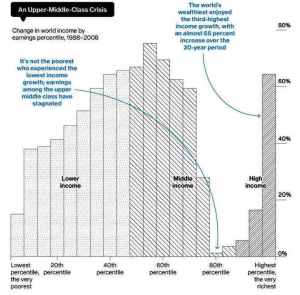
The headline states, Income Inequality Study: Upper Middle Class Stagnates.  The caption over the key chart says, An Upper-Middle-Class Crisis.  Here is the chart as it appeared in the article.

Change in World Income - Glassman - Businessweek Bloomberg - 20131107

Okay, the author wants us to believe that a group of people he labels “upper-middle-class” is having a crisis, because their incomes did not increase appreciably over a twenty-year period ending in 2008.  There are so many things wrong with this statement, that it is difficult to know where to begin.  Here are some things you should notice about this chart.

  1. The chart describes world incomes, not incomes in the United States, and we don’t know the population it describes.  The study was conducted by Branko Miloanovic and Christopher Lakner for the World Bank, so we might assume it was a study of the member countries of that organization.
  2. The height of the bars represents the percent that income in each group changed over a twenty-year period, not the percent that income changed for any individuals or even any groups of individuals.  It is important to realize that the same individuals are not necessarily in each group over that time period, and in fact, it is unlikely that an individual would remain in the same group over that span of time.
  3. Grouping incomes into lower, middle, and upper levels represents an arbitrary classification scheme.  The authors chose to label all incomes below the 45th percentile as lower incomes.  They grouped incomes from the 45th percentile to the 85th percentile as middle incomes.  Finally, the incomes above the 85th percentile were considered upper incomes.
  4. Income levels and social classes are not the same thing.  Furthermore, the wealthy and affluent may have incomes in the middle or even the lower percentile groups as defined in this study, depending upon how they structure their wealth and manage their expenses.
  5. The distribution of incomes is not statistically normal.  The extremely high incomes of a small percentage of people skews the distribution making the interpretation of the chart very difficult, perhaps impossible.

Is it a crisis that income levels between the 75th and 95th percentile of incomes didn’t change very much between 1988 and 2008?  Is this a crisis for the members of society that we call the upper-middle class?   The answer to both questions is no!  In fact, the study did not consider how much the incomes of individuals or those in the upper-middle class changed over that 20 year period.  A person who might have had an income level at the 75th percentile in 1988, might have an income in the 95th percentile or possibly the 5th percentile in 2008.  The study has nothing to do with how much incomes of individuals changed, or what social classes they might be assigned.

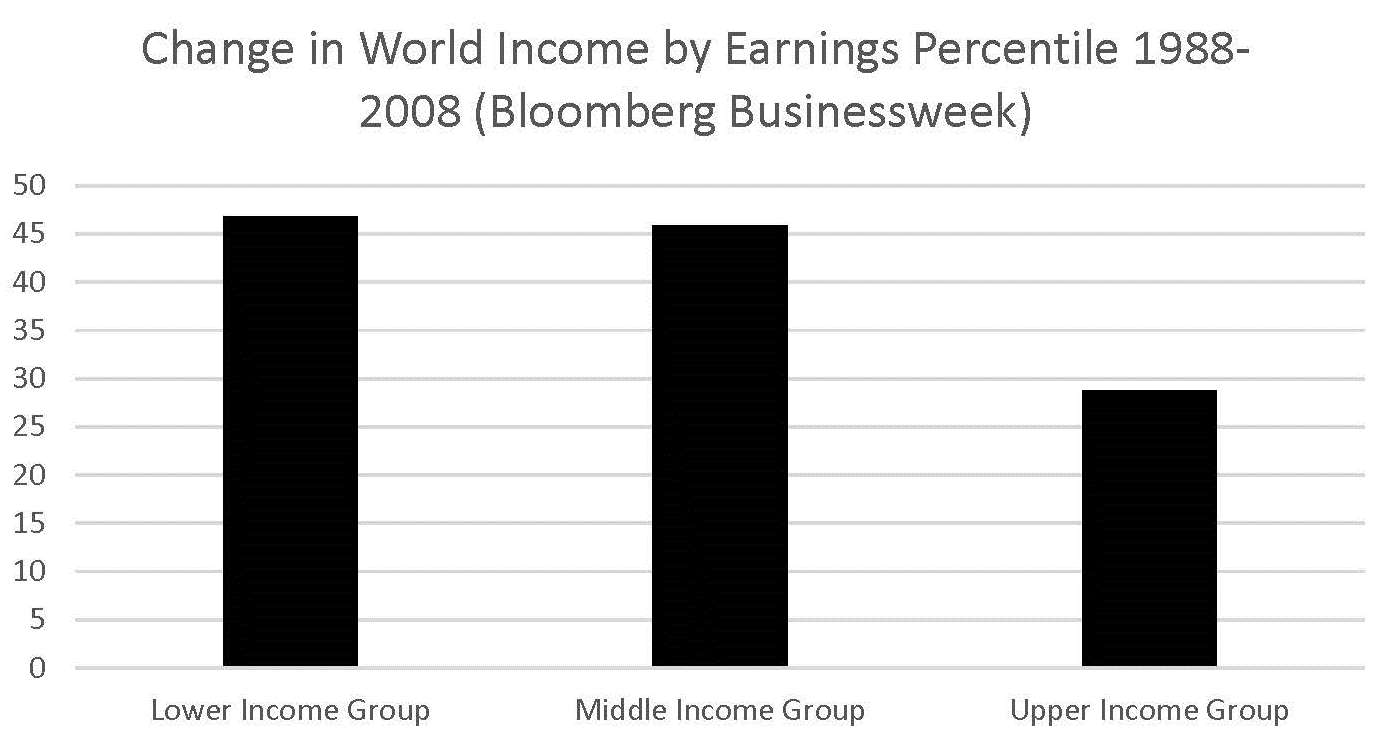
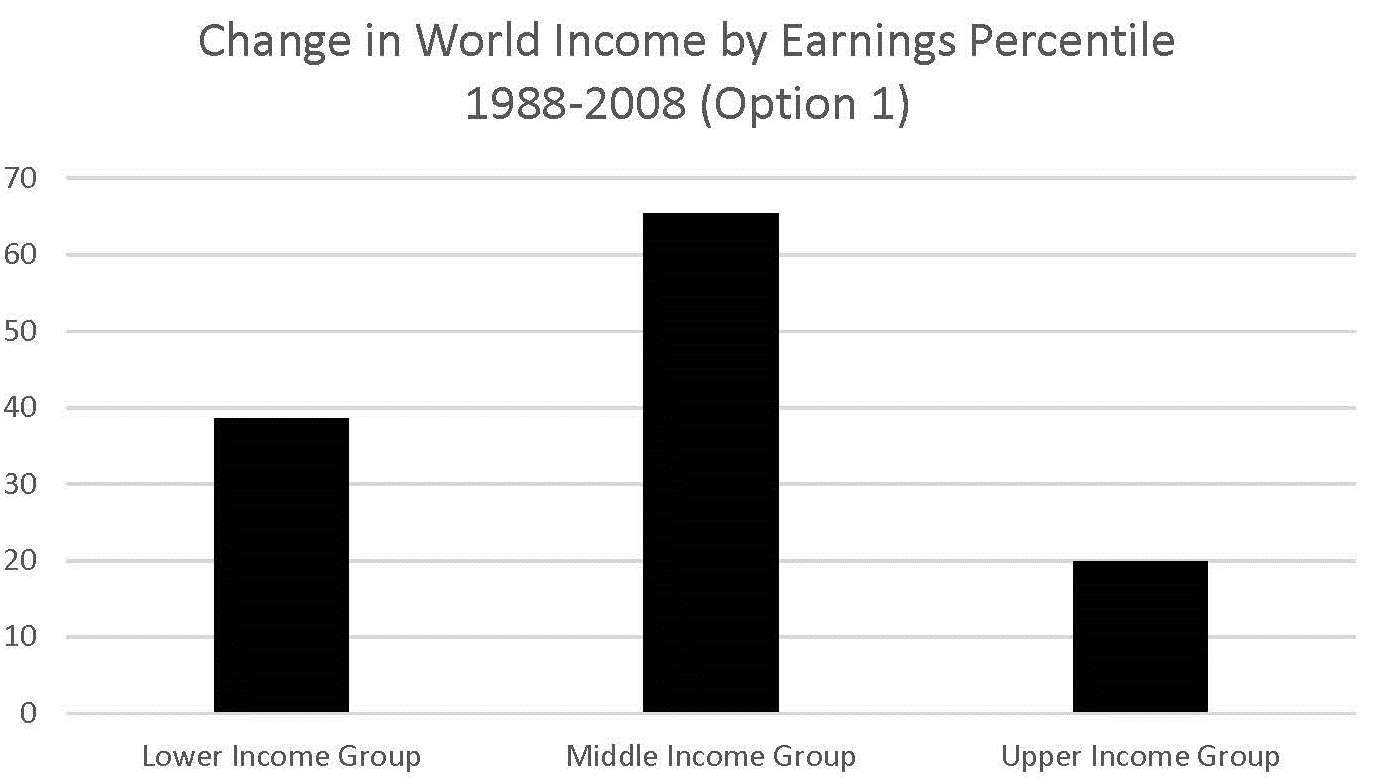
Using the categories defined in the article, I calculated the income changes for the lower, middle and upper income groups. (See below.)

Chart 1

The average incomes of the lower income group increased 47 percent while the average incomes of the middle income group increased 46 percent between 1988 and 2008.  This income change is about 2 percent per year.  During the same period, average incomes of the upper income group increased 29 percent which is about 1.3 percent per year.  Again, remember that the same individuals are not necessarily in the same group over the 20 year period.  Many of the individuals who were in the lower income group in 1988 are most likely in the middle or upper income group in 2008, and their incomes have changed considerably.  The study did not address this circumstance.

What would the same population look like if the categories were defined differently?  For example, I calculated the average income change for each group if the lower, middle, and upper income groups were defined as the lower third, middle third, and upper third of income levels respectively.   (See below.)

Chart 2

As this illustrates, the change in world income by group depends on how you define each group.  The lower third of income levels only increased about 39 percent, the middle third by 65 percent, and the upper third by only 20 percent.  Now where is the crisis, if there is one?

When people first become employed, their incomes are likely among the lowest percentiles of income levels, perhaps even less than minimum wage.  Over a 45 to 55 year working life, their incomes generally increase as they change jobs, gain experience, and further their education and training.  Upon retirement, their incomes often drop, but they may have accumulated some assets and enjoy fewer expenses.  But this is only a generalization.  How incomes change, how they are distributed within any population, and how they vary in different jobs and careers is far more complex than this study indicates.  And the authors were engaged in nothing more than statistical tomfoolery when they proclaimed a crisis.

It turns out that income inequality is really a good thing!  It means you have an opportunity to increase your income, and your lot in life, as you gain experience, seek further education, and pursue career opportunities that match your skills.  Equality of opportunity is all we can expect.

Lies, damn lies, and statistics!

Posted in Media, Politics | Tagged , , , , , | Leave a comment

The Untrammeled Right of Free Speech

Is the United States of America an exceptional nation?  I believe so for a number of critically important reasons.  When I heard a recent immigrant from England asked this question, I listened with curious anticipation for his answer.  After an extended pause, a deep breath, and with apparent passion and conviction in his voice, he responded, “Absolutely!  Although, it is at risk.”  He continued, “For a start, it is the only country in the world in which you have an untrammeled right to free speech that is unprecedented in history and unmatched.”  He went on to mention other liberties we enjoy by saying “There really is not another place where you can become of that country, and nobody will question you.” The totality of this response inspired me, but the specific mention of the “untrammeled right of free speech” caught my attention.

The Bill of Rights of the United States Constitution was ratified effective December 15, 1791.  Amendment I states the following.

Congress shall make no law respecting an establishment of religion, or prohibiting the free exercise thereof; or abridging the freedom of speech, or of the press; or the right of the people to peaceably assemble, and to petition the Government for a redress of grievances.

What do we do when competing values are in conflict?  We absolutely value this “untrammeled right to speak freely.”  We cannot imagine any governmental authority acting to stifle that right, prohibiting us speaking in public settings or enjoying private conversations with friends, family members, professional colleagues, or even casual acquaintances.

We also value transparent government in which we the people may observe our elected and appointed representatives as they conduct the business of government at all levels.  How else can we hold them accountable?  How else can we know they are acting in the best interest of their constituents?  Furthermore, we most certainly value justice, the consistent application of the laws of the land.

Suppose you are at a dinner table in a restaurant with another person or even several others.  It might be a social occasion and not an official meeting of any kind.  Suppose you are with fellow members of a board of directors, a city council, a county commission, or some other officially recognized governing body.  In the state of Florida, as well as in many other states, you would be in violation of the law and subject to severe penalties if you discussed certain issues, concerns, or topics.  This would be true whether you are alone with that person in a private setting or part of a larger group in a public place such as a restaurant.  People have been prosecuted for violating this law.  The legal consequences are serious.  Ironically, if you are a member of the state legislature, you would be exempt from this  limitation of your right to speak freely and privately to other members of the legislature.  How can this be?

Of course, I’m talking about the Florida Sunshine Law.  The law was established many years ago to guarantee open and transparent government.  It is comprehensive and well tested by numerous cases.  Every year various public boards, commissions, and local units of government are reminded of this law which serves as a guide to their deliberations and operations.

According to the Sunshine Law, if two or more members of a public body are together, except during an official meeting conducted in the public after due notification, they are prohibited from discussing anything that might possibly come before that body for action or any consideration in the foreseeable future.  The purpose of this provision is obvious, and most people are sympathetic to the justification of the legislature in responding to the concerns of citizens that special deals were being worked out in the proverbial smoked-filled rooms.  The law intends to bring all public deliberations under a very bright light, the sunshine, so that the actions of these governing boards remain open to review and accountability.  In the state of Florida, thousands of governing boards fall under the Sunshine Law.  You can read about this law at MyFlSunshine.com.

The Florida Legislatures that created and perpetuated the Sunshine Law weighed the matter and decided that transparent government trumps freedom of speech, except for themselves.  Why the exemption?  They realized it would be very difficult, if not impossible, to conduct the business of the legislature if they were prohibited from privately discussing the important issues coming before them.  Of course, any board, commission, or council could make the same argument.  Apparently, the Florida Legislature decided that these local bodies are not to be trusted.  Ironically, local governing boards are closer to the people who hold them accountable for their actions.  In truth, local units of government are more directly accountable to their constituents than the state legislature and no less likely to violate the public’s trust.

Over the years, I’ve participated in and observed many public governing boards struggling with important decisions.  Occasionally, it seemed painfully obvious that private conversations might have improved the possibility of wise decisions.  Members of these boards, acting in good faith and with honest intentions, could sometimes benefit from frank deliberations in private settings.  Unfortunately, throughout history such private sessions too often resulted in abuses of power, back room deals, politics before public interest, personal intimidation, and a myriad of other wrongs.

The Sunshine Law limits the rights of certain individuals in order to protect the interests of the greater community, but bad or poorly considered decisions can be an unintended consequence.  The individuals making these decisions are not free to speak to each other in private.  They may not know or appreciate information or the interests of the other members of the governing body.  They may be reluctant to share their own preliminary thinking in a public setting for fear of being misunderstood.

So, it turns out that the untrammeled right of free speech is not so untrammeled after all.  In my opinion, the Florida Sunshine Law is wrong to limit freedom of speech.  Numerous checks and balances exist that prevent members of boards from acting irresponsibly and without accountability.  The United States Constitution should trump the Florida Sunshine Law.  Better government results from transparency and freedom of speech, not from just one or the other.

Posted in Human Behavior, Musings, Politics | Leave a comment

Young vs. Old and Other Artificial Dichotomies

In my most recent post, I admitted to being old, conservative, and educated.  Labels!  Why do I associate myself with such terms, and what do they mean?  What age is old?  What does it mean to be a conservative?  How can I claim to be educated?

Each of these categories defies definition.  Young versus old represents an artificial dichotomy.  We could argue all day and all night about the meaning of these terms and who should be pigeon-holed into one or the other of these categories.  Accept by mutual agreement, we would never know for sure who is old and who is young because these labels represent rather arbitrary categories along a continuum.  In truth, we are conceived, born into this world, live our lives, and then pass on to our great reward.  There is no precise milestone that qualifies us to claim old age.  It is just a label for the sake of stereotyping.  The same could be said for conservative versus moderate versus liberal, or educated versus not educated.  We know one when we see one, but we cannot agree on what it is that we know or see.  Fascinating!

Consider almost any label ascribed to humans and you will most likely find an arbitrary set of categories.  Race, level of affluence, physical attributes, ethnicity, and even gender all require placing humans into groups that actually make little sense, but we do it anyway, all the time, even officially.

Asking people to classify themselves into races or ethnicities is a wonderful example of the futility and the absurdity of this endeavor.  It would be funny if it weren’t so serious.  Over the past fifty years, the definitions have changed numerous times as have the words that go along with the definitions.  To further complicate the matter, nationality gets added to the equation as does religion and you have a bunch of nonsense that serves the convenience of stereotyping, often for nefarious purposes.  Every person on the planet descends from 64 great-great-great-great-grandparents or 256 great-great-great-great-great-great grandparents.  Which ones determine your race, ethnicity, or nationality?  Good luck figuring that out!

Of the three ideological labels in common use today, conservative, moderate, or liberal, the largest number of Americans (U.S.A.) consider themselves conservative (38%) compared to moderate (34%) or liberal (23%) according to a Gallup poll reported this past January.  Gallup has been collecting this self-identified information about people for more than 20 years and the results have been interesting.  The general trend is toward more liberals (17% to 23%), fewer moderates (36% to 34%), and fewer conservatives (43% to 38%).  Why we choose to label ourselves this way is a fascinating question.  I wonder how many people even know what the labels mean.  For the details of the poll, check out the Gallup Website at www.gallup.com.

I choose to label myself as a conservative, and I  have my reasons based upon certain principles that I hold to be critically important.   I actually don’t like the term conservative because it has its own dictionary definition that seems semantically distinct from my meaning.  I intend to explain this in a future post.  I will not attempt to define moderate and liberal, except that they are not conservative.

Thanks for enduring my musings.

Posted in Human Nutrition, Musings, Politics | Tagged , , , , | 4 Comments

On Being Old, Conservative, and Formally Educated

hs-2006-10-a-full_jpgDoes the Earth revolve around the Sun and who thinks it does?  Who believes that astrology is a scientific discipline?

Professor of Law and Director of the Demography of Diversity Project at Northwestern University, James Lindgren, JD, PhD., explored these questions in his analysis of a National Science Foundation (NSF) study Science and Technology: Public Attitudes and Understanding (2014).  

It turns out that quite a few people do not understand the orbital dynamics of our planet. Furthermore, many people apparently argue that astrology is a science.  As a former college science professor, I’m not surprised.  I also know that many science professors do not know that Millard Fillmore once served as President of the United States, or that Ljubljana is the capital of Slovenia.  I can’t even pronounce it.

Professor Lindgren was not concerned about orbital mechanics or astrology.  He faithfully accepted the suppositions that the Earth orbits the Sun once a year and that astrology is not a science.  He focused instead on who believes these ideas.  It turns out that the more politically conservative and the older you are, as well as the more formal education you have, the more likely you are to believe that the Earth indeed revolves around the Sun and that Astrology is not a science.  As a crusty old conservative with several advanced degrees, I was delirious with joy at these results.

Ironically, the “correct” answer to the question about the Earth revolving around the Sun was wrong or at best imprecise, but there was no better answer in the NSF survey.  It turns out that both the Earth and Sun move around a constantly changing center of mass of a much larger collection of masses that includes the solar system and it’s galactic and intergalactic neighbors.  The apparent motion of the Earth depends entirely upon where you are observing that motion.  If you are standing in a swamp in Florida, you would be absolutely convinced that the Sun rises in the east and sets in the west while revolving around the Earth.  If you were on the Sun, you would think otherwise, but you would not have long to think about it.  If you were watching the Sun and the Earth from the planet Mercury, you might observe the Earth rising and setting once every couple of months while it revolved around you.  Depending upon whether you are on the sunny side or dark side of Mercury, you might think the Sun is always in the same place or that it doesn’t exist at all.  Now stretch your imagination and consider yourself an inhabitant of some far away planet orbiting around a star in the Andromeda Galaxy.  If you had an incredibly powerful telescope and a lot of time on your hands, you would observe that both the Sun and the Earth were in fact revolving around the center of the Milky Way Galaxy.  So what is the right answer?  Is the Earth revolving around the Sun once each year?  Not exactly!  “None of the above” would be the better answer, but the survey didn’t allow that response.

Astrologers study the apparent motions of the planets and stars as seen from the Earth.  They assign psychological and social value to the patterns they observe.  No matter how accurately they measure these planetary motions and their relative positions within the constellations of the Zodiac, they cannot identify a causative influence that determines whether you are having a good day or a bad day.  It is hypothesizing without verification.  Astrology certainly considers information gathered through careful observation, but the conclusions do not follow from continuous testing of hypotheses.  Astrology is not a science, but that is not a criticism.  It is a matter of definition.

Nothing is ever as simple or straightforward as it seems, just ask Isaac Newton.  Oh, he’s dead.

Posted in Astronomy, Musings, Politics | Tagged , , , , | Leave a comment

On Being Human and Biased

Last I checked, all newspaper, radio, Internet, and television reporters are human.  The same holds true for commentators, bloggers, editors, publishers, photographers, videographers, and the guy or gal that delivers your paper.  Being human, they have world views, attitudes, passions, slants, frustrations, agendas, causes, special interests, conflicts of interest, cognitive dissonance, interpersonal relationships, and contractual obligations.  In other words,  they are biased.

Some are honest about it, others are not.

ATT00146As consumers of news, we have a responsibility to recognize this.  I trust the honest ones, but I don’t trust anyone who says they are free of bias.  You shouldn’t either.  We counter this absolutely normal human quality by selecting and considering a variety of news sources.  We learn to ignore the dishonest ones, or listen with an always skeptical mind.  Why pay heed to someone that does not tell the truth?  How do you ever know when to believe a dishonest person?

Bias is a good thing.  Honesty about one’s biases is refreshing.

Fair is an odd word that often surfaces in this same conversation.  It is quite possible to be both biased and fair, but dishonesty is never fair.  Fair is usually in the eye of the beholder.  What seems fair to me, might not seem fair to someone else.  It is hard if not impossible to be fair to everyone.  We usually appreciate such an effort, but we don’t always appreciate the consequences.

On most mornings my iPad and my coffee help me clear the cobwebs.  To get the news, I scan various online news organizations and publications.  After determining whether the world has come to an apocalyptic end while I was sleeping, I then read opinion pieces, editorials, and various blogs because I enjoy the provocations of these honest writers who are not embarrassed to tell you what they think.  I find it fascinating to read completely different perspectives about the same news item or issue.

Over the years, I’ve become quite selective in my choice of news sources. In addition to respecting the opinions of certain commentators who are honest about their biases, I do not respect, nor do I continue to read or listen to others.  The following are obvious indicators or characteristics of news sources and opinionators that I do not respect.

They demonize those with whom they disagree.

They are condescending and arrogant in their tone.

They exaggerate and sensationalize to push their agendas.

They are ignorant about the issues they address.

They are unencumbered by the facts.

Come to think of it, I don’t vote for people like this either.

Posted in Human Behavior, Media, Musings, Politics | Tagged , , , , | 1 Comment