Lumping

Lumping, we all do it.  Sometimes it helps us, sometimes it doesn’t.  Sometimes it gets us into serious trouble.  You cannot get through a day without a whole bunch of lumping going on.  Talk to a friend, watch an advertisement, listen to a news report, read or write anything, and you are either a victim or a perpetrator of lumping, and usually both.  What am I talking about?

It’s a simple idea, but also rather profound.  We lump better than computers, much better. We can look at someone, even from a great distance in dim light, and often lump them quite successfully.  No supercomputer could do this.  We can look into the eyes of a total stranger, and in a fraction of a second lump them.  They wouldn’t even know what happened.

I’m not just talking about people lumping people.  We lump things too, all the time.  Do you ever buy organic food?  Do you know what that means?  What about fresh produce?  Or artificial sweetener?  Or green revolution?  Or global warming?  Or low-fat? Or liberal, radical, tea-party, or conservative?  All these descriptors lump.  Do you really understand what they mean?

Lumping is necessary.  We cannot communicate without lumping, and we do like to communicate.  But, watch for the subtle choice of words or phrases and consider the lumping motives of the source.  Here are some types of lumping that may mislead us.

  • stereotyping and profiling
  • sweeping generalizations
  • arbitrary and artificial dichotomies or polychotomies
  • ad hominems

One of my favorites is lumping by example: a football player gets arrested for some horrible crime, even murder, and the entire team gets lumped.  Another favorite is lumping by the average:  you shouldn’t go to that college because the graduation rate is low.

Do you remember “Sticks and stones may break my bones, but names will never hurt me”?  Right!  When you call your little brother a jerk, you are lumping him in with all the jerks of the world and he’s supposed to know exactly what you mean.  When someone says “Golly, it’s hot out today,” we know what that means.  Today has been lumped with all hot days, even though not all hot days are the same.  I challenge you to have a conversation without lumping.

Unfortunately, there are certain lumping words and phrases that you should never utter, not among friends, not even when you are alone.  For God’s sake never write them down.  Here are some examples . . . oops!  See what I mean.

Beware of lumping, it can take you down a road you may not want to travel.

Posted in Human Behavior, Musings | 1 Comment

Earth From Saturn: A Different Perspective

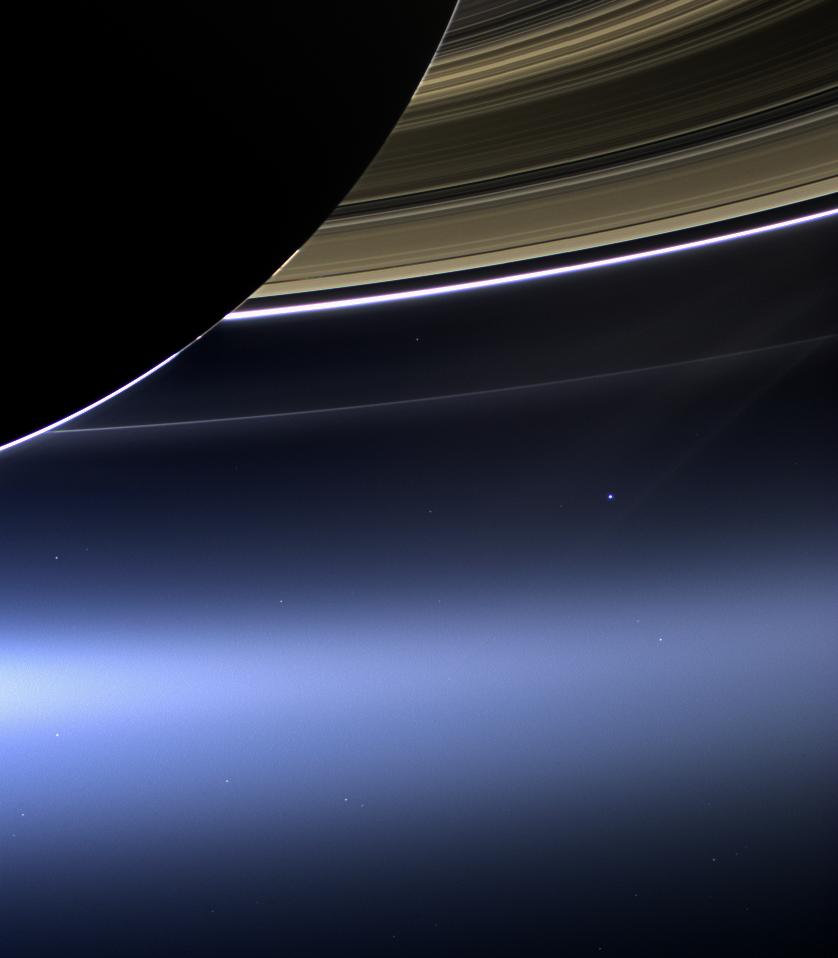
What would Earth look like from Saturn?  NASA provided an answer to that question with this stunning image.  That bluish-white dot below Saturn’s rings on the right side of the picture is the Earth as seen from 838 million miles away.  If you look closely you might notice the Moon protruding as a slight bulge on the right side of the Earth.  Because of the great distance involved and the resolution of the picture, it is hard to see.

This is actually a look back in time as are all astronomical photographs.  Light from the Sun traveled for about 8 minutes before reflecting off the Earth and Moon.  It then traveled across our solar system to the camera on the Cassini spacecraft orbiting Saturn.  We are seeing our home planet as it appeared more than 1 hour and 34 minutes before the picture was taken.

The NASA website provides information about this Cassini photograph and others at this link:  http://www.nasa.gov/mission_pages/cassini/multimedia/pia17171.html.

Photo Credit: NASA/JPL-Caltech/Space Science Institute

Photo Credit: NASA/JPL-Caltech/Space Science Institute

Posted in Astronomy | Tagged , , | Leave a comment

Perspective

Keeping our perspective when flooded with breaking news alerts, well-crafted talking points, juicy sound bites, screaming headlines, and 140-character tweets, among other insults, requires effort.

Every single day we are assaulted with a torrent of sensationalism to grab our attention.  It includes purposeful distortions and exaggerations often with shocking videos.  So, how do we keep our perspective and our sanity when so much of the information about our world comes to us filtered through these imperfect sources?  How do we counter this maelstrom of misinformation, this deluge of drivel?  Without perspective, we may embrace rather strange notions of our world.

To satisfy my curiosity, I looked at news items currently listed on the CNN app on my iPad.   This is a snapshot taken on a rather ordinary Sunday afternoon in July.  There were 50 so-called Top-Stories, and I classified them according to subject matter.  To be fair, I could have chosen Fox, MSNBC, ABC, CBS, AP, USA Today, Drudge, or any number of news outlets.  CNN opened first.

Various crimes were the subject of 28 percent of the stories with murders being the most common.  Another 30 percent were related to pop-culture, and most of these describe the strange happenings and uncommon lives of celebrities.  Another 12 percent were about disasters of one kind or another.  The remaining 30 percent related to politics, religion, science, technology, medicine, nature, education, and the economy, but only one or two stories about any one of these subjects.

Another way of analyzing this snapshot of CNN’s Top Stories is to consider what proportion is positive or negative, uplifting or possibly depressing.  This will not surprise you: fully 80 percent describe something bad–if it bleeds, it leads!  If it blasts, it lasts!

The media compete for audience and the revenue thus derived.  We just want to understand our world, or do we?

Our daily experiences profoundly influence our world view.  Distortions, exaggerations, and blatantly biased information all challenge us to navigate our days.  We can draw false conclusions and make bad decisions with serious consequences for our families, our communities, and indeed for the entire world.

Every important news story or headline that lingers for more than a day gets a tag that draws vivid and fertile associations.  These tags create the meme that spreads like a malicious virus forever infecting our minds with a false reality. Consider the following subjects.

  • Self-Defense/Stand-Your-Ground
  • Global Warming/Climate Change/Climate Disruption
  • The Obesity Epidemic/Health Crisis
  • The IRS Scandal/Government Intrusion/Political Favoritism
  • The Right-To-Privacy/National Security
  • Terrorism/The War on Terrorism
  • Racism/The Struggle for Civil Rights
  • Bird Flu/Swine Flu/Pandemics
  • Education Reform/A Nation at Risk/Failing Schools
  • Health Care Reform/Obamacare
  • Freedom of Choice/Abortion Rights/Right-to-Life/Anti-Abortion/Pro-Life
  • Evolution/Creationism/Intelligent Design

Each of these complex issues conjures notions and emotions related to our experiences and the information and attitudes we encounter.  Allow me to analyze just one of these as an illustration.

Try this experiment. Ask a friend if public schools are rotten. Chances are your friend will answer yes! Ask why, and you will hear about the high dropout rates, declining SAT scores, violence, drugs, incompetent teachers, and an array of other reasons that public schools are failing. Case closed!

Where did we get these ideas about public schools? Mostly, they derive from media reports but often from politicians and the media’s talking heads, as well as from various friends and family members—it becomes the unquestioned truth that virtually everyone accepts.

Few of us ever study the public schools or make an effort to determine whether the dropout rates increased or if SAT scores declined, to mention just two of the arguments listed above.  We share anecdotes from the experiences of our children and friends, as well as from our own memories from years ago. If we already hold a strong opinion that schools are rotten, then we tend to believe those anecdotes that reinforce our belief. In reality, none of these memes is actually correct.

The Gallup organization periodically surveys us about public schools.  It is ironic that a majority of respondents agree that schools are failing, but most report that the particular school their children attend is fine and their teachers are good.  This seemingly paradoxical finding makes my point.  We are victims of false ideas which are difficult and even impossible to challenge or verify.

More Americans have high school diplomas than ever before. Don’t believe me?  Go to the U.S. Census Bureau and check it out for yourself. The percentage of adult Americans with high school diplomas increased from less than 10 percent in the early 20th Century to almost 90 percent today, and it has never been higher than now.

Have SAT scores declined?  Average scores declined in the 70’s and early 80’s because of efforts to encourage more students to attend college.  Access to higher education increased significantly and many more people were taking the SAT. If you compare the average SAT score of each gender and of different ethnic groups, you will discover that these subpopulations actually increased their average SAT scores during that 20 year period, but that was never reported–it wasn’t newsworthy.  The average scores have continued to increase with significant gains in certain subpopulations.   In the 1960’s only about 10 percent of the adult population in our country completed a college education with at least a bachelor’s degree, that percentage is now over 30 percent among adults.

Similar explanations exist to refute the other arguments supporting the notion that our schools are rotten. I’ve selected just two in order to make my case.

It is very difficult to keep our perspective when what we hear or read is only a very small and often distorted part of a larger story about which we have little knowledge and limited experience.

We do need perspective.
Posted in Human Behavior, Media | Tagged , | Leave a comment

Fear, Alarmism, and Politics

Fear motivates us, or it should.  How we react to fear may have serious consequences, even life or death consequences.  Sometimes we find ourselves in terrifying circumstances, and we don’t have time to ask questions or to contemplate the deeper philosophical meaning of that danger.  At other times, we may lack the knowledge or competence to judge the severity of the threat even when it is not imminent.  In either case, something really bad may happen unless we do something.

History is replete with extreme examples of tyrants and despots who controlled their populations through fear.  Closer to home though, parents use fear to control their children.  Husbands and wives use fear to control their wives and husbands.  Police officers use fear to get us to pull over when we are speeding.  Advertisers use it to get us to buy their products.  Insurance companies use it to get us to buy more insurance.  Newspapers and news broadcasters use it to get us to read newspapers, watch news programs, and buy the products of their advertisers.  Fear is part of life, we cannot avoid it, but we can learn to recognize and manage it.

Alarmism is a special case.  It is the unwarranted raising of fears.  It is an exaggerated call for action.  If we don’t have time to ask questions, how should we react?  If we lack the knowledge to evaluate the alarm, what should we do?  Alarmists take advantage of these pressures of time and of our ignorance.  We can learn to spot Chicken Little.  It is in our best interest to know when the alarm is real or false.  Our checkbooks may depend upon it, or our blood pressure, or our lives.

Last Thursday, I watched a U.S. Senate hearing of the Committee on Environment and Public Works, chaired by Senator Barbara Boxer of California.  The title of the hearing was Climate Change: It is Happening Now.  There were two panels of experts, one focused on the atmosphere and the other on the oceans.  Most of the experts were scientists, but some were not.

One memorable testimony was offered by a representative of the insurance industry.  He began with an assumption that we are facing a serious crisis as a result of catastrophic global warming caused by human activities, specifically the burning of fossil fuels.  If we accept his assumption, then we should be afraid.  More to the point, the U.S. Senate should be very afraid and take appropriate action to save us from the end of the world as we know it.  After admitting he was not an expert on climate change nor even a scientist, the panelist presented several specific recommendations for the senators to consider.   These were offered based upon his expertise in the field of insurance.  Perhaps it is not surprising, but insurance companies would profit greatly from each of his recommendations, and taxpayers would pay for those increased profits.

This panelist used fear to persuade legislators to spend taxpayers dollars to increase profits for his industry.  He argued for immediate action and he obviously recognized the senators lack of knowledge of the subject–few are climatologists, oceanographers, or actuaries.  If you watched the hearings, that was painfully obvious!

It is also obvious that one political party is invested in the reality of the crisis, the other party is not.  If you are a politically ambitious senator or representative, you must deal with the pressure either to conform to your party’s position or to change it.   To change the position of a political party requires effective leadership and political savvy.  Being at odds with the leadership of your own political party, is not a formula for fulfilling your political ambitions.

One of the tactics used by certain senators and panelists during the hearings was to discredit those who challenge their position or its basic assumptions.  These ad hominem attacks are used when rational arguments are unavailable.  Some were subtle, others not so much.

For much of the hearing, very few of the senators were actually present to hear the testimony of the expert panelists.  More often than not, there was a strong correlation between which political party was present in the hearing room and which point of view was being expressed by one of the experts.  It is not too surprising that Democrats invited some panelists and Republicans invited others.

The hearing was a perfect case study of confirmation bias, political ambition, ignorance, and arrogance.  It was a classic demonstration of dysfunction in government.

This begs the question, which should we fear more: climate change or congress?

Posted in Human Behavior, Politics | Tagged , , , | Leave a comment

Names and Labels

A few random thoughts about names and labels . . .

The planet we live on and call “Earth” should be called “Ocean”.

Indiana is mistakenly named for an indigenous people who had very little to do with India, nor were they truly native to America.

White people are not white.  Black people are not black. Hispanic people come in all shades.  All humans have the same skin pigments, just differing amounts at different times and places.

All modern humans have African ancestors.  All modern humans have dark skinned ancestors.

Black dogs usually have pale skin coloration.

Hispanic refers to a national origin, not a race or ethnicity.  Latino describes a family of languages, not a race or ethnicity.

The differences in skin color within the races are greater than the differences between the average skin colors of the races.

There is no such thing as race!  We invented the construct of race in order to categorize people who look different, come from different parts of the world, speak different languages, or have different cultures.

Classifying a person as belonging to the white group or black group is no different than classifying a person as part of the tall group of humans, or the short group, or the blue-eyed group, or the brown-eyed group, or the freckled group, or the curly-haired group, or the bald group, or any other way of categorizing humans into groups based upon their outward appearance. Due to unfortunate, often tragic, and even horrific occurrences in our country and around the world, the classification based upon skin coloration, ethnicity, and geographic origin became part of our language.  Ignorance and emotion greatly complicated the matter.  Then politics took over.

In historic and prehistoric times, there is considerable evidence that humans of all appearances, ethnicities, and geographic origins have enslaved and savaged each other.  No group of humans is innocent of this legacy.

Not all Christians agree on who is a Christian.

Not all liberals agree on who is liberal, and not all conservatives agree on who is conservative.

We can more easily agree on who is a Democrat, an Independent, or a Republican, but only in certain states.

Enough of this . . .

Posted in Human Behavior, Musings | Leave a comment

Ignorance or Emotion

A friend commented on Facebook: “Why are there so many ignorant people?”  The comment reflected the friend’s obvious frustration in trying to understand why so many people behave stupidly and say crazy things in response to George Zimmerman being found not-guilty by a jury.  The friend’s comment reflected a deeply felt emotion.

As I looked through the many comments that followed, I noticed that most of them were emotional statements.  In fact, almost all of them were passionate expressions of one sort or another.

First of all, all humans are ignorant, even the wisest among us.  We all are capable of demonstrating our ignorance, behaving stupidly, and saying crazy things.  It is our nature (and our nurture) to form opinions and attitudes emotionally, then to act in response to these feelings, without thinking.  Once these attitudes are formed, it is often difficult for us to change our minds.  We become emotionally invested in our ideas and opinions.

We form this habit of emotional ideation early in life because we lack the knowledge or experience to form our opinions rationally.   With maturity, we should learn to question, even analyze our opinions and attitudes, and their emotional basis, before we act, speak, or make important decisions.  Unfortunately, we don’t always do this.  Some among us almost never do this and it becomes a habit or a way of life, often with tragic consequences.

Ironically, responding to danger emotionally without much thought usually protects animals and helps them survive.  Likewise early hominid hunter-gatherers lived in a world that required a quick response to danger without much time for meditation.  Responding emotionally is not so helpful for modern humans living in complex societies.  But, this is how we are wired.

We also suffer from confirmation bias.  We tend to form our opinions based upon our feelings, and then we pay great attention to the supporting evidence while discounting or completely ignoring that which would change our minds.  We fool ourselves into believing we are behaving rationally.   We often remain firmly attached to these attitudes and opinions, and thoroughly invested in them.

If we find ourselves getting angry when we observe crazy behavior in others, or when an idea of ours is challenged, we should suspect that we are victims of confirmation bias.  The anger reveals the emotional foundation of our position.  This does not mean we are wrong, necessarily.

It is my impression that some people gravitate into positions of authority where their opinions and decisions are not subject to questioning by those they consider their subordinates.  They surround themselves with people who learn not to challenge their authority.  They do not seem to think it is necessary to explain themselves.  Unfortunately, we see this among many in leadership roles in all walks of life.

Passion is another dimension to our emotional lives, and it is a wonderful aspect of our character and a source of our humanity.  Passion without rationality is madness.  Passion without rationality in authority is tyrannical.

Yes, we are all ignorant or we are just ignoring our God given wisdom because it is so much easier to just emote?

Posted in Human Behavior | Tagged | Leave a comment

Life is a Journey

Recently I was asked if there was anything in my life and in my career that I would change, if I could journey back in time.  There certainly were some difficult times, but they were learning opportunities.  Without those experiences, I would not be here today.

If life is a journey, then what are the rules of the road?  How should we conduct ourselves as we experience our own personal journey?

  1. In life, there are no shortcuts, so seek wisdom, knowledge, and competence, and then confront important challenges along the way.
  2. A long and difficult passage through a dark and ominous valley helps to better appreciate the often breathtaking view from the mountain’s summit.
  3. When confronted by threatening strangers, choose your battles carefully, and always consider what is best for the long road ahead.
  4. When storm clouds gather along the way, as they certainly will, look for the silver-lining-there is always a silver-lining!
  5. As you always have a choice, take the high road, and do what is right for the right reasons.
  6. In life, you only experience one journey, so appreciate the path you have chosen, and learn from all your experiences.
  7. A successful journey is measured by how you have traveled and by where you can go from now.

I try not to expend too much emotional energy on those things about which I have no control.  The past is gone forever.  Its only value is what we can learn as we journey onward into our future.

Posted in Biographical | Leave a comment