The Debate is Settled

Bets get settled, debates are won or lost, and facts can be stubborn things.  Science, on the other hand, helps us to better understand or to become enlightened by learning something new.

Are we ever finished learning?  Do we ever know everything?  What about facts?

SOTU provided a case study into the evolution of a sentence.  In his address this past Tuesday night, the President stated the following.

The debate is settled: climate change is a fact.

Can you imagine the speechwriters’ interminable deliberations about how to handle this?  Do you suppose an earlier draft declared that science is settled?  Someone must have pointed out that science doesn’t get settled, so science morphed into debate.  Apparently, in the minds of the speechwriters there are two sides to this debate.  Is climate change a fact or perhaps not a fact?  Is it true or false?  Yes or no?  Good or bad?  Is there actually a debate about whether the climate changes?  Can the President declare the end of a debate and that settles it?  Executive power reaches new levels of authority.

In truth, it is about the message, a political message.  The President and his advisors assume that we will ignore the actual meaning of the sentence, but accept the underlying message and move on.  What is the intended message anyway?

Like all presidents, this one has an agenda that he wants to pursue.  He’s impatient for the people and their congress to support his energy policies.  He rationalizes and justifies his proposals by arguing that continuing the burning of carbon based fuels ultimately results in catastrophic consequences for the environment, particularly global warming.  There is opposition to his agenda, as there often is when various interest groups have a stake in the outcome of a political debate.  The opposition argues that the President’s proposed energy policies create serious economic hardships for everyone through higher costs for fuels, increased taxes, and regulatory burden.

So why are we arguing over whether climate change is a fact?  In truth, we are not.  The statement uttered in the State of the Union Address is inane!  It offers an empty and insubstantial notion lacking any significant meaning or logical point.  Is anyone debating whether the climate changes?  Anyone who knows anything about climate knows that the Earth’s climate is always changing, always has and always will.  Anyone except those who believe the nonsensical proposition that the climate was perfect and unchanging until we began putting gasoline in our cars and heating our homes with wood, coal, oil, natural gas, and cow dung.  Listen carefully to their statements and you will hear this underlying assumption.

Ironically, the same folks who came up with the sentence declaring that climate change is a fact, also invented an equally trite cliché.  They want to combat climate change?  Does that mean we should adopt their policies and the climate will stop changing?

MIT Professor of Climatology, Richard Lindzen, Ph.D., put it quite succinctly as he addressed members of the UK Parliament this past week.  He told the committee:

Whatever you decide to do will have no impact on your climate, but will have a profound impact on your economy.  . . . trying to solve a problem that may not be a problem by taking actions that you know will hurt your economy.

And this makes no political sense.  The debate about energy policy is not settled.  Whether the climate changed in the past or how it might change in the future is irrelevant to the policy discussion.

Allow me to offer some scientific evidence about climate change.  This first graphic image is of temperature (blue) and carbon dioxide concentrations (red) during the current interglacial which commenced about 12 to 18 thousand years ago.  The data came from a Greenland ice core.  You should note two important points about these temperature trends: 1) temperature changes over time; and 2) the current warming observed since the middle of the seventeen century follows one of the coldest periods since the end of the most recent glaciation.  With regard to amount of carbon dioxide in the atmosphere, at this location it has been increasing rather steadily for about 8000 years.
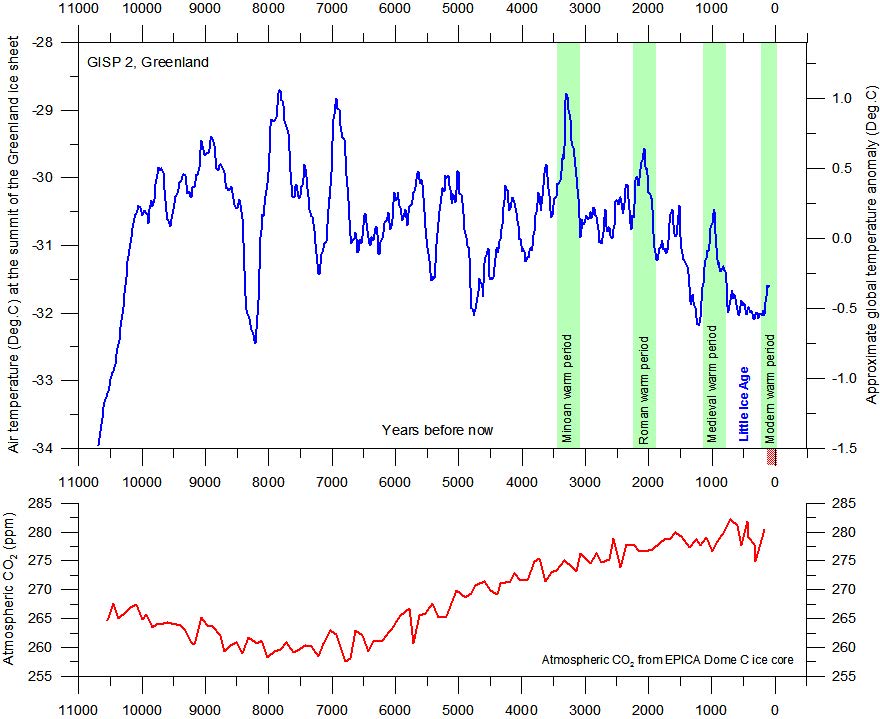
Greenland Ice Core Temperature and CO2 11000 BP

The second graphic below depicts global temperature trends over the entire earth over the past 35 years.  Scientists at The University of Alabama at Huntsville analyze the data from NASA satellites.  Their analysis describes temperatures in the lower troposphere over the entire earth surface.  This represents the global temperature record since the first satellites were placed into orbit for this purpose only in the late 1970s.

There are five temperature trends showing the south polar, southern, equatorial, northern, and north polar regions.  Again, you should notice that temperature does change with time and with the seasons particularly in the polar regions.  Over this time period, it has been warming in the Arctic, cooling in the Antarctic, but not so much of either in the other regions.
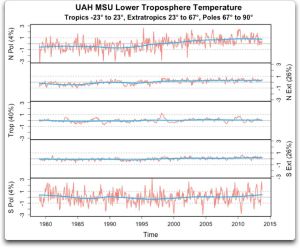
UAH Lower Troposphere Temperature Trends 1980 to Present

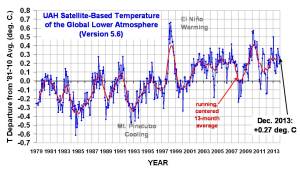
This last graphic image below is the monthly global average temperature from analysis by the scientists at the University of Alabama at Huntsville.  This derives from the same satellites data as the chart above but averages all five regions.   You should note that seasonal variation is minimal because it is winter in the northern hemisphere when it is summer in the southern hemisphere and likewise for spring and fall.  Average global temperature changes from month to month and year to year.  Ever since the El Nino of the late 1990s, the global average temperature has been generally higher than before that rather influential weather phenomenon, but importantly, there has been a hiatus in the general trend of rising temperature for about 15 years. UAH_LT_1979_thru_December_2013_v5_6So the climate changes and that debate is finally settled.  The sun rises in the east and that debate is settled as well.  Morning follows night and that debate is over too.  Nice to have all of this established.  Now perhaps we can get on with the public policy issues before us.
Should we make energy more expensive for everyone, hurting the poor disproportionately more than the affluent?  Should we do this based upon a completely false notion that somehow we will stop the climate from changing or prevent the planet from warming?  Should we support an energy policy that will ruin our economy and have no measurable impact on climate change?
Posted in Climate Science, Politics | Tagged , , , , | 3 Comments

About Oceans

New England and PEI 2009 (106)Fear is a strong motivator.  We’re wired that way.

Senator Sheldon Whitehouse (D-RI) is justified in his fear of rising sea levels and he wants to do something about it.  Last June he received the National Marine Sanctuary Foundation’s (NMSF) Leadership Award for his work to protect oceans and combat climate change.   The following statement appears on his Senate Website.

For coastal states like Rhode Island, our oceans are a vital part of our economy and our history, and we must take smart steps to manage and protect them as a resource for future generations.

The sea is rising, and in some places the land is also falling.  Both are true for the Atlantic Coast of the United States.  This is not a new phenomenon.  Sea levels have been rising for at least 12 thousand years, and the long-term rate has remained relatively steady for as long as we have been monitoring it.  (There is large year-to-year variability.)  Furthermore, the Atlantic Coast of North America has been dipping down for at least that long, ever since the continental ice sheets began retreating at the beginning of the current interglacial.  As ice sheets retreat and melt, the water runs down hill to the oceans.  The continental crust that was under that enormous weight moves upward while fresh water is added to the worlds oceans.  Land surrounding and under the Great Lakes and Hudson Bay continues to rebound to this day.  At the same time, the Atlantic Coast is east of the pivot point of the rebounding continental crust, and so it dips down and will continue to do so until the ice returns during the next glacial period.  Complicating the issue somewhat is the fact that the Atlantic Ocean is also getting larger and wider.  Just visit Iceland to see the spreading mid-ocean ridge.  The igneous activity along the 40 thousand mile long global mid-ocean ridges is also releasing water and carbon dioxide into the oceans and into the atmosphere.

These geological processes as well as others are fairly well understood.  The rates of spreading and isostatic rebound have been measured quite accurately.  Every year, Europe is a little farther from New York than it was the year before, and Minnesota is a little higher.  At the same time, Japan is a little closer to California as the Pacific Ocean is closing.  It is also true that as the oceans warm, the water does expand.  Add all these process together and you understand the challenge addressed by Senator Whitehouse.

Now if Senator Sheldon Whitehouse is smart, he should be working on solutions that help our coastal communities adapt to these inevitable changes.  Unfortunately, he seems to be focused on combating climate change, an incredibly expensive battle that cannot be won.  I fear that he is fighting the wrong war.

Posted in Climate Science, Politics | Tagged , , , , | Leave a comment

Choose Your Battles

It was my grandmother who often offered this wise advice.  Unfortunately, advice is easily offered, but not so easily followed.  When emotions hijack us, we’re in no mood for thoughtful consideration.

Yesterday, the United States Senate Committee on Environment and Public Works conducted a hearing entitled Review of the President’s Climate Action Plan.  It lasted four hours, but it seemed like 40.  It was obvious that several of the senators suffer an amygdala hijacking unencumbered by grandmotherly advice.  Don’t ask me why I chose to endure such torture.  I don’t have an adequate excuse.

The hearing commenced with each senator making a statement.  Back and forth they sallied for exactly one hour and seventeen minutes, first a Democrat then a Republican with each side contradicting the other.  This occurred without much evidence that either side was listening to or considering the positions of the other.  The statements were prepared, and the senators read them with occasional outbursts and excursions off-script.

Each side had its favorite talking points.  The Republicans expressed concern that the administration, through the Environmental Protection Agency, was over-regulating without congressional authority.  They also argued that the Climate Action Plan was not based upon sound science and if implemented would devastate the economy without making any significant difference to the global climate.  The Democrats argued for the need to combat climate change.  They repeated the notion that a lack of action to reduce carbon pollution would lead to long term catastrophic consequences.  There were other points and counterpoints, but these were the primary themes.

Two panels of experts waited patiently and passively to testify.  Of these nine individuals, two were active climate scientists and the other seven represented various government agencies and non-governmental organizations.   It was the testimony of the scientists that motivated me to watch this Webcast in the first place.

I’m not particularly interested in politically motivated pontifications or the agendas of various special interests, but I am keenly interested in the science.   I found myself strangely fascinated and somewhat depressed by the statements of the senators.   Certainly, their statements were prepared by their staffs.  Of course, they must stick to their templates.  Changing their minds is as likely as winning the lottery, three times in a row.

The wonder of science is that our understanding does change.  There is nothing settled in science, neither the facts nor their interpretations.  Science is the continuous pursuit of knowledge.  I used two important words in that sentence, continuous and pursuit.  No matter how much we know, there is always more.  Often what we know turns out to be incorrect, and that is a good thing.  It means we learned something important.  The history of science is full of examples where so-called settled science turned out to be absurdly wrong.  No one recognized it, or perhaps just one persevering and courageous skeptic who dared to challenge the orthodoxy, the consensus.

Today, scientists know as much about climate as they know about what goes on in the centers of galaxies, which is not very much.  It is a relatively new interdisciplinary field of study meaning that you need to know some physics, chemistry, biology, geology, and many other sciences in order to grasp the whole of atmospheric dynamics.  Ironically, the very term “climate” is an invention, a construct.  There really is no such thing as a climate.  Consider the definition and you will see what I mean.  It refers to the average weather conditions for a specified region over a period of time.  The region may be a local environment or the entire planet.  The period of time might be a few years or decades, or it might mean multiple millennia.  The temperature is just one of countless measures that might describe a climate.

The number of factors that influence and change our atmosphere over time is incomprehensible.  The important point is that it is always changing and always will.  There is absolutely nothing we humans can do to prevent the climate from changing.  Heaven help us if we think we can control the sun, the motion of tectonic plates that make up the earth’s crust, volcanic eruptions on the continents or under the oceans, or the oscillations of currents in the world oceans among other forcings.

The notion of combating climate change as articulated by several senators is beyond ridiculous.  It is embarrassing that we elect people to serve us who should be so ignorant and arrogant.

The idea that carbon dioxide is a pollutant makes about as much sense as considering oxygen, nitrogen, and water to be pollutants.  All of these substances are vital to life on our planet.  Too much or too little of any one of these critical atmospheric components would be detrimental.  Using the euphemism “carbon pollution” instead of “carbon dioxide” is just an Orwellian propaganda tactic, and a transparent one for sure.

Allow me to conclude with a chart derived from a study published in Nature by Vinther, et. al., in 2009.  It shows a temperature trend from an analysis of an ice core from Greenland.  The temperature at different depths of the ice core is calculated using the relative concentrations of two different isotopes of oxygen.  This graphs represents 18 thousand years.  Remember that all of human civilization occurred within the most recent 10 thousand years.  Also remember that this represents just one location on the surface of the Earth.  Scientists have no record of global average temperature before the late 1970’s when the first satellites were placed in orbit to monitor atmospheric temperature trends.  Finally, remember that this represents only 4 ten-thousandths of one percent of the age of our planet.

Greenland Ice Cores from 18000 BP

The problem for atmospheric scientists is that they do not understand how global temperature changes occur naturally.  Therefore, they cannot say with any certainty how much of the warming that occurred in the most recent 20 years of the twentieth century might have occurred naturally.

It is obvious from this Greenland ice core, and many other studies, that our planet experienced a relatively colder episode known as “The Little Ice Age” which commenced about 1400 AD.  The warming from that cold period began about 1650 AD and has continued rather unsteadily to the present.  There is nothing unique about the recent warming compared to past warming such as occurred in the 1800’s.  In Greenland, significantly warmer temperatures than at present occurred from 6000 BCE to 3000 BCE and again during the Minoan, Roman, and Medieval warm periods.

Carbon dioxide is a greenhouse gas and fortunately for us, the atmosphere is warmed by its presence as well as by other greenhouse gases, most importantly water.  Without these gases that absorb infrared (heat energy), our planet would be a very cold place.  No credible atmospheric scientist disputes this.  There is considerable dispute about the relative importance of the various greenhouse gases and more importantly about feedback, positive or negative.  This is an active area of research.  Over most of the surface of the Earth, carbon dioxide contributes little to the greenhouse effect, being overwhelmed by water vapor and clouds.  There are many natural sources of carbon dioxide in the atmosphere that dwarf human or anthropogenic sources by many orders of magnitude.  Much of the observed increase in atmospheric carbon dioxide over the last 60 years that we have accurately measured it, can be explained by the natural warming of the oceans.  We are currently in an interglacial known as the Holocene.  The most recent glacial period ended somewhat abruptly, in geologic time scales, about 12 thousand years ago.   The oceans have been generally warming ever since and outgassing carbon dioxide as a result.

Before we enter combat against climate change, I suggest we take a deep breath, and exhale some carbon pollutants.  The plants will love us for it.

Posted in Climate Science, Politics | Tagged , , , , , , | 2 Comments

On the Closing of Parks and Bridge Lanes

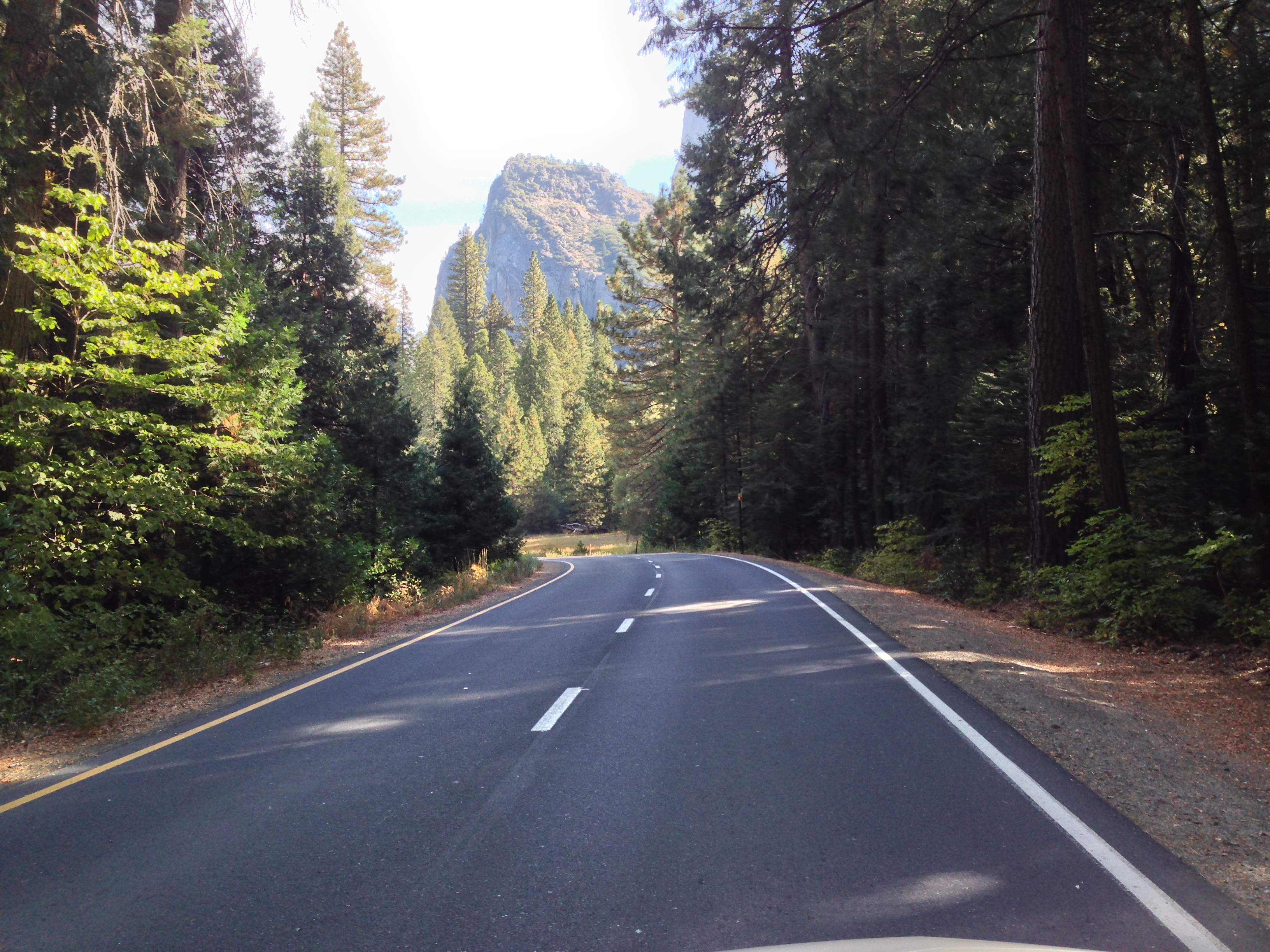
Yosemite - Fall 2013What is unexpected about this photograph?  It’s Yosemite National Park on a pleasant Sunday afternoon in the fall, but that is not unusual.  It is a beautiful scene, one enjoyed by millions of visitors each year, but that is neither strange nor unexpected.   Give up?

You would expect some of those millions of visitors would object to me stopping in the middle of the highway, getting out of my car, and taking this terrific photograph.  No one objected because no one else was there, not a soul.   The Park was closed!  For us, it was not a problem because we had rented a private cabin, and therefore enjoyed limited access.  We couldn’t hike into some of the more remote areas because of the closure, and also because my wife broke her right foot several days before this photo was taken.  She wasn’t in the mood to do any hiking.

There are 401 National Parks in the United States, and last fall they were closed to visitors for several days and in some cases for several weeks.  The media certainly reported about the park closures, but little was made of the consequences of this purely political decision.

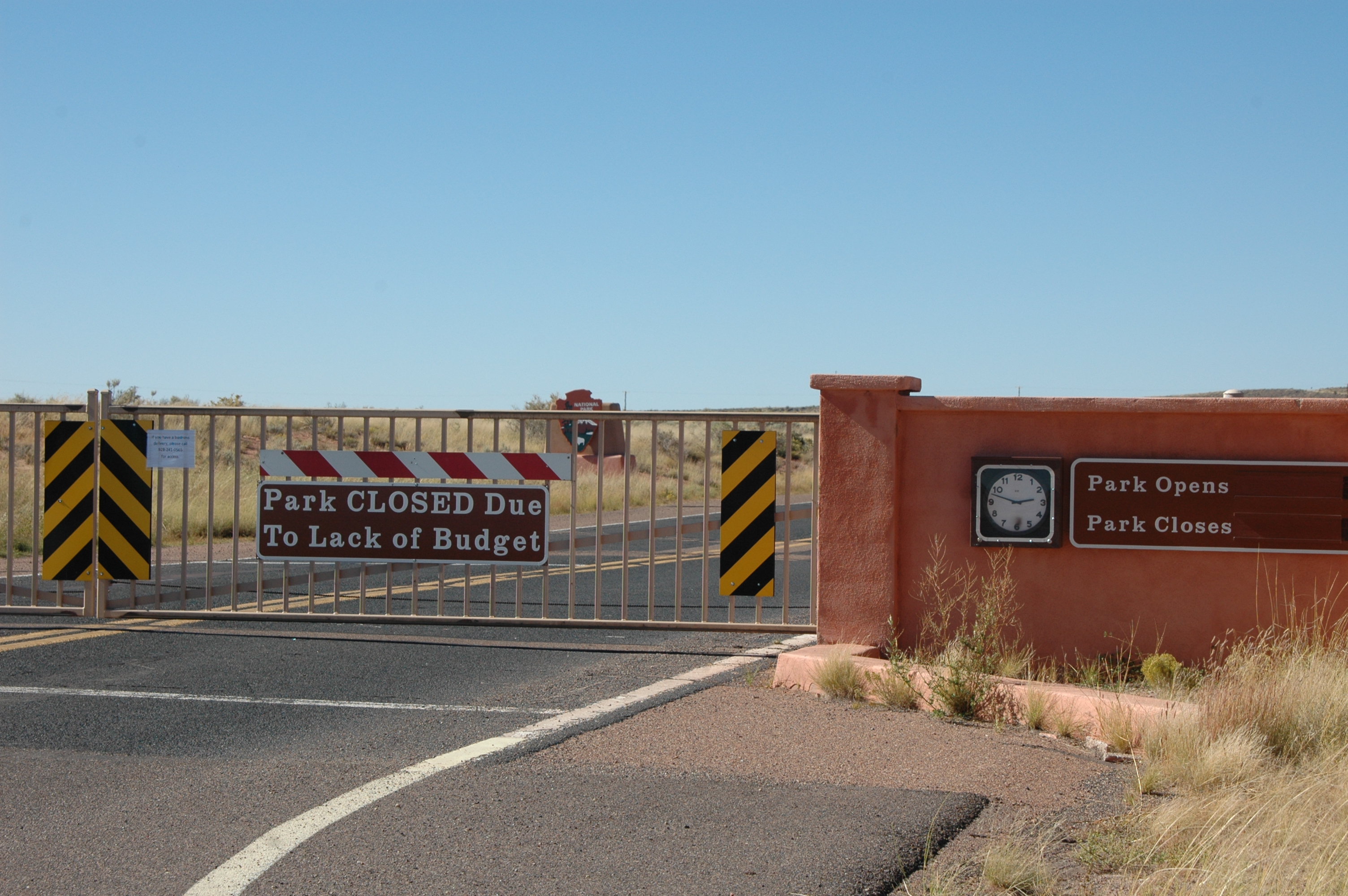
As luck would have it, my wife and I were traveling during this time and were slightly inconvenienced by these closures.  There was only one park we could not enter at all, and we laughed as we saw the sign on the gate.  A scenic road through the park connects Interstate 40 to U.S. Highway 180 in Eastern Arizona.  Southwest Vacation 2013 (2098)Closing Petrified Forest National Park inconvenienced some people who would normally use this route to Woodruff, AZ, about 26 miles south of the park entrance.   We questioned the logic of this closing but went on our way.  For us there was a silver lining, we were able to get to Meteor Crater, AZ in time to see it and enjoy the museum before it closed for the day.  It is not a national park.

After the shutdown ended, I remember reading that the closures were actually unnecessary.  I was appalled by accounts of veterans attempting to visit the World War II Memorial in Washington, D.C.  Everywhere we traveled we noticed large numbers of travelers from United States and many other countries, and we wondered how many had been disappointed, inconvenienced, and even hurt financially or worse by this failure of our federal government.  All of this is old news by now, or is it?

For the last week, certain media outlets have been obsessing over the dirty politics of closing a lane of traffic for four days in New Jersey.  For those of you who watch the news, you’ve heard horror stories of the people inconvenienced by this traffic nightmare.  There was even a death allegedly caused by this corrupt political act.

I wonder how many horror stories went untold when the United States Government shut down for 16 days last October?  Was the shutdown of the federal government and  the closing of national parks and memorials a political act intended to punish someone?

I’m not surprised by media bias, everyone has a bias.  I just wish they would be honest about it.

Perhaps I’m naïve, but isn’t the purpose of government to make life better?  Isn’t the purpose of the media to discover the truth?

Posted in Media, Musings, Politics | Tagged , , | Leave a comment

Don’t Be Deceived

Things may not be as they seemWe can be so easily fooled by an illusion or by what someone tells us.  It happens all the time.  in the photograph at the right, it appears that I’m leaning on a large cactus, which would not be wise in most circumstances.  Can we believe our lyin’ eyes?  How do we know the truth?

When experts tell us something, it is natural to believe what they say.  There is a fallacy known as argumentum ab authoritatum (an argument from authority).  Just because a source is an authority on a matter, doesn’t necessarily mean what we are told is true.  It might be, but then again, maybe not.   But we are at a disadvantage, because we don’t have the expertise to refute the argument.

There is a corollary to this fallacy known as argumentum ad verecundiam (an argument to shame).  This occurs when the so-called experts remind the skeptics of their ignorance in an effort to stifle any contrary opinion from being heard.

What could be more authoritative than a United Nations organization comprised of thousands of scientists issuing reports claiming 95 percent confidence in the following statement?

Human influence on the climate system is clear. This is evident from the increasing greenhouse gas concentrations in the atmosphere, positive radiative forcing, observed warming, and understanding of the climate system.

Who would dare to disagree with such an august organization?

About 25 years ago, the Intergovernmental Panel on Climate Change (IPCC) was created by the World Meteorological Organization and the United Nations “. . . to assess all aspects of climate change and its impacts, with the intention of formulating realistic response strategies.”  To date, the IPCC has published four reports, and is in the process of releasing the Fifth Assessment (AR5) in 2013/2014. The Summary for Policymakers of the AR5 was published this past September 27th.

Without disputing the claims of the AR5, I offer some observations which everyone should know about our world and its climate.  These are facts derived from reading the IPCC reports as well as many other sources.  I believe most reputable scientists would agree with these statements.

  1. Climate changes, it always has and it always will.  There is no such thing as a normal or even a typical climate for any location or for our entire planet.  The Earth’s climate changed in the past, before humans or any life existed on our planet, and it will continue to change in the future.
  2. A large number of factors contribute to climate change, some very important, other factors contribute to a lesser extent.  Many factors influence climate over the long-term,  over thousands or even millions of years, while other factors may cause significant local or even global changes in climate over a very short span of time.
  3. Weather describes atmospheric conditions for a specific time and place.  Climate describes average weather conditions.  The global climate characterizes the average weather conditions for the entire planet.
  4. Human activities can affect weather by changing the atmosphere, the oceans, or even the surface of the land.  Human activities which influence long-term and wide-spread weather patterns would necessarily and by definition change the climate in a location or on the entire planet.

So what is the problem?  Where is the disagreement?  Why is there so much angst over the issue of global warming and climate change?

Scientists do not know how much humans influence global climate, because they do not yet understand how the climate changes naturally.  The argument is over whether we can do anything about it, and if so, what should we do.  It is a political argument in which the various interests lack sufficient information to win the debate.

Some would argue that doing nothing guarantees the catastrophe.  This is a straw man argument, because many people, governments, and organizations are actively pursuing answers and solutions.  Furthermore, which catastrophe are we choosing to avoid?  Do we spend our limited resources to prevent a dangerously hot planet or one that is very cold when the current interglacial comes to an end.  What if extreme and costly efforts prove to be unnecessary?  We may be fortunate to live on a planet that quite naturally adapts and moderates in response to our many insults.  Quite possibly, natural forces would overwhelm our efforts to control climate through human technology and political will, and we will have destroyed our economies in an act of catastrophic folly.

Contrary to the arguments of the climate alarmists, I believe we have time to better understand the earth’s atmospheric dynamics before we choose a proper course of action to ensure a prosperous future for our country and all of humanity.  And the last thing we need to do is stifle the voices of reason, on either side of this or any other argument.

Posted in Climate Science, Human Behavior, Politics | Tagged , , , , , | Leave a comment

Red Herrings, Aunt Sallys, and CAGW

IMG_0889Herrings are not red and Aunt Sally is a straw man.  On the other hand, if you cure herring in a strong brine solution, it will turn red and become quite pungent.  If you wish to distract a hound from chasing a rabbit, you might use a red herring, at least that’s the theory and the explanation of the idiom.

In the United Kingdom, I’m told, an Aunt Sally is the same as a straw man, a misrepresentation of another person’s argument.

So, when your Aunt Sally throws you a smelly fish, you’ve been had, as they say.

Such is the grand debate about manmade global warming with rising and acidifying oceans, melting glaciers and polar ice caps, drowning polar bears, super storms and typhoons, and many other calamities that may be summarized as the sky is falling, at least Chicken Little thinks so.

Do you believe that the burning of fossil fuels with the release of enormous quantities of carbon dioxide into the atmosphere is catastrophically changing the climate?  Are you convinced  that sea level is rising so fast that big cities such as New York and Miami will be under water by the end of the twenty-first century?  Do you accept that our oceans are becoming dangerously acidic, and that important marine ecosystems are being destroyed as a result?  Do you argue that we can prevent these catastrophes by finding alternative sources of energy that do not produce or release carbon dioxide?

If you answered yes to all of these questions, then you believe in catastrophic anthropogenic global warming, CAGW.  Congratulations!  Your heart is in the right place and I appreciate your strong concern for our future, but ask your Aunt Sally to stop throwing smelly fish all over the place.

You see, most of us understand that climate changes naturally.  We believe that modern science is yet unable to discern the extent to which current climate changes may result from human activities, the consequences of modern civilization.  Most of us wonder if we could or should do anything to prevent global climate change, as if there was a perfect global climate we need to maintain and protect.  Like our ancestors, we prefer to focus our efforts and our limited resources on adaptions that improve our chances for survival on this dynamic planet.

I believe this is the position of the vast majority of us, including well-educated and extraordinarily talented scientists.  For these beliefs, we are called deniers and skeptics, or worse, by a rather loud minority.  Our arguments are often misrepresented, and therefore misunderstood.  We do not deny that our planet may be warming.  We do not deny the benefits of alternative and renewable sources of energy.  We know that science is never settled and that consensus has its proper place in politics, but not in science.  We remain concerned and quite skeptical of arguments that cannot be verified.  We resent the condescension and the ad hominem attacks of those who question our intelligence and our motives.

I found an example that illustrates my point.  This interchange occurred earlier this month on CNN with Piers Morgan.  The invited guests included climatologist and former NASA Scientists Roy Spencer, Ph.D., of the University of Alabama, Huntsville, and environmental journalist Mark Hertsgaard, of The Nation magazine.  Dr. Spencer is a well-know author and an expert on the satellite measurement of global temperatures.  He has testified before the United States Congress on many occasions.  Mr. Hertsgaard holds strong opinions that manmade climate change and global warming will have catastrophic consequences in the future.

The following excerpts are from a transcript of their interchange.

SPENCER: Well, even though I’m a skeptic, I don’t know of anyone that denies climate change. The climate has always changed. . . The earth is a little warmer right now. We’re not exactly sure whether it’s 100 percent due to mankind or 50 percent due to mankind, 50 percent due to nature and by chance. Today we have a new paper (interrupted)

HERTSGAARD: Mr. Spencer, that is not true, sir. That is not true. You are misstating with facts. As a scientist (interrupted)

SPENCER: Which part is not true, Mark?

HERTSGAARD: You should not do that, sir. To say that we don’t know.  Listen to what the IPC just said – IPCC just said in its report that humankind’s activities are now responsible for most of this. I frankly don’t know why, Dr. Spencer, I believe that you don’t even agree that climate change is manmade last time I checked.  And if you’ve revised your position I’d love to hear about it.

SPENCER: Well, you’re wrong about that. I believe that we don’t know – I don’t believe that we know how much is manmade versus natural. (interrupted)

HERTSGAARD: So you stand against the 97 percent of scientists who say this. And, Piers, I have to tell you as a journalist, you know, we don’t talk to tobacco scientists any more when we do cigarette stories. I don’t think that we should be talking to climate deniers about climate stories. That is journalistically irresponsible.

SPENCER: Mark, did you know I’m one of the 97 percent you’re talking about, because that 97 percent statistic included people who believe that some portion of climate change is manmade. And I do believe some portion of it is.

HERTSGAARD: Sir, sir – see this is the conspiracy thinking that you must retreat to in order to say in the year 2013 that climate change is not manmade, happening now, and causing great suffering in the Philippines, great suffering.  And we have not dealt with this for 20 years because of this kind of nonsense, talking about how there’s no human fingerprints on this. That is not what 97 percent of the scientists on this planet say. And Piers, I repeat, journalistically this is malpractice to have on somebody pretending that this is 50 percent and 50 percent when nobody in the scientific community takes the view that climate change is not the related to stronger storms.

MORGAN. Okay, well look, listen, it’s an interesting debate. I think it’s actually journalistically malpractice to not have a fair debate actually, with all respect to you, Mark Hertsgaard. But thank you very much for the lecture on journalism.

If you were to watch the interview, you would observe Mr. Hertsgaard interrupting Dr. Spencer and talking over him, often not allowing him to complete a sentence.  These few paragraphs include at least five Aunt Sallys and red herrings, and some rather disrespectful ad hominem attacks thrown in for good measure.

Examples of Aunt Sallys or straw man arguments of Mark Hertsgaard that misstate the position of Roy Spencer:

So you stand against the 97 percent of scientists who say this

to say in the year 2013 that climate change is not manmade, happening now

talking about how there’s no human fingerprints on this

somebody pretending that this is 50 percent and 50 percent

the view that climate change is not the related to stronger storms

Examples of red herrings that Mark Hertsgaard used to distract from the debate:

And, Piers, I have to tell you as a journalist, you know, we don’t talk to tobacco scientists any more when we do cigarette stories.

this is the conspiracy thinking that you must retreat to

causing great suffering in the Philippines, great suffering

That is journalistically irresponsible

And Piers, I repeat, journalistically this is malpractice

Examples of Mark Hertsgaard’s ad hominem attacks of the character of Roy Spencer:

Mr. Spencer, that is not true, sir. That is not true. You are misstating with facts

I don’t think that we should be talking to climate deniers about climate stories

we have not dealt with this for 20 years because of this kind of nonsense

That is not what 97 percent of the scientists on this planet say

nobody in the scientific community takes the view

I would paraphrase Mark Hertsgaard arguments as follows: If I want your opinion, I’ll give it to you.  Furthermore, we should not allow anyone who disagrees with me to speak.

This is just the tip of the proverbial iceberg.  For too many years, perhaps decades, reasoning voices have been stifled and interrupted.

In my future posts, I intend to share information about global climate change that should help you avoid Aunt Sally and the stinking red herrings before they distract you from catching that rabbit.

Posted in Climate Science, Human Behavior, Politics | Tagged , , , , , , , , , | 1 Comment

Complexity, Simplicity, and Belief

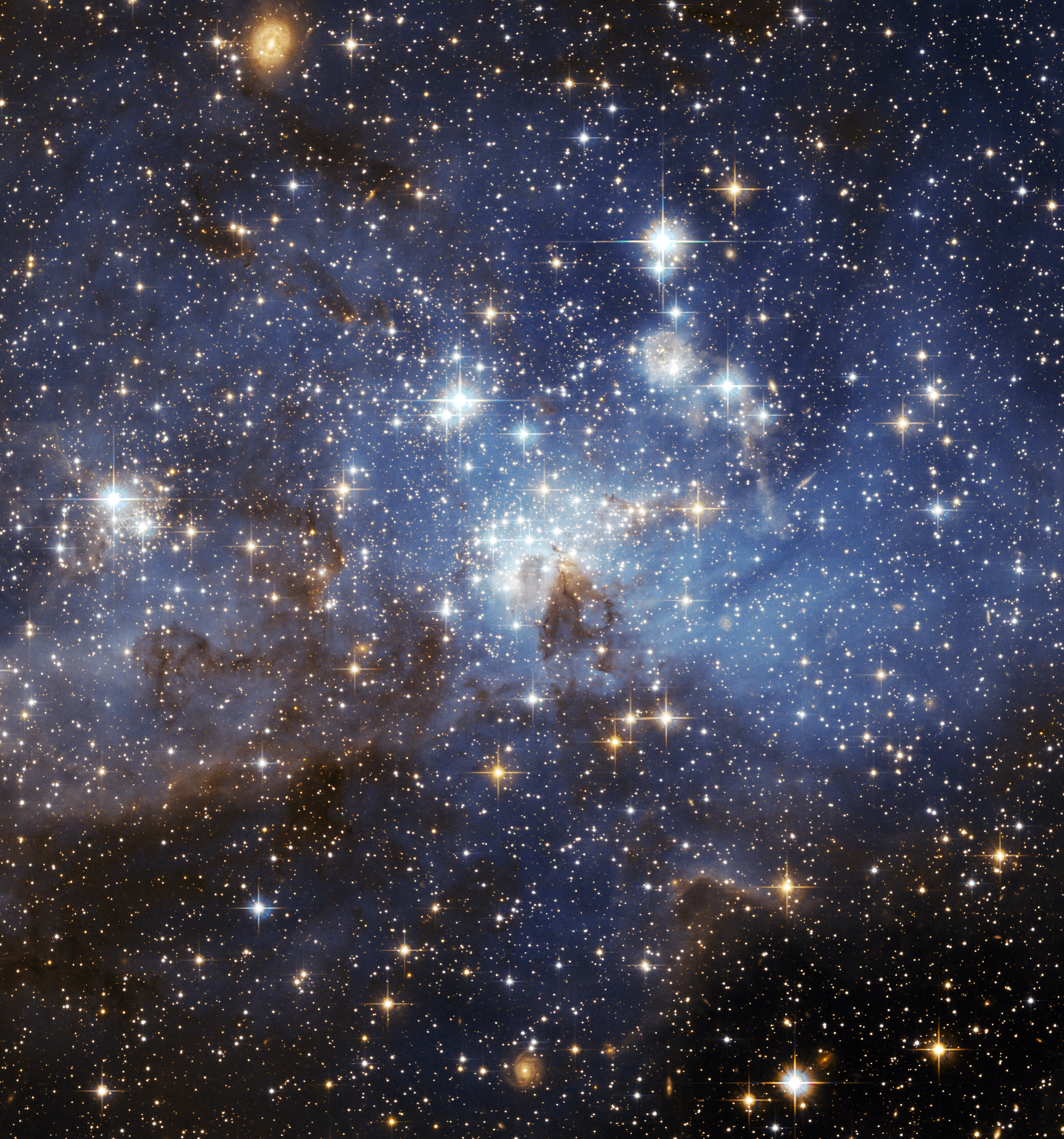
hs-2006-55-a-full_jpgThere exists a profound tension between the incomprehensible complexity of our universe and our inclination to simplify what we observe in order to afford us a practical understanding.  The consequence of this tension is belief.  Our lives as individuals, the continuing prosperity of societies, the very survival of homo sapiens, and the future of life on this planet depends upon these notions and emotions that constitute our beliefs.

Because we can never know everything about anything, we naturally consider what we do know or feel, and we act in accordance with our beliefs.  Often, life goes on and all is well.  Unfortunately, sometimes we screw up, big-time!  With more than six billion people thinking, feeling, believing, acting, propagating, and more than occasionally screwing up, this incomprehensible complexity of our universe can bite us on the proverbial derriere.

In 1938, Enrico Fermi won the Nobel Prize in Physics for his work in nuclear science which included his demonstrations of the existence of new radioactive elements produced by neutron irradiation, and for his related discovery of nuclear reactions brought about by slow neutrons.  If you would like to be convinced about the incomprehensible complexity of our universe, try reading some of his papers or just go to Wikipedia and read about his work.  My point?  He would be considered an intelligent person by most of us.

Fermi wondered why scientists failed to find evidence of intelligent life elsewhere in the universe.  With billions of stars in the Milky Way and an uncountable number of other galaxies existing over a time span of many billions of years, why does it appear that we are alone?  Or as a corollary to this question, where is everyone else?  These questions form the Fermi Paradox, and many wise people have failed to offer an acceptable answer, a plausible hypothesis, or even a simplistic belief.

One popular explanation suggests that modern civilizations “screw up big-time” before they solve the complex problems of interstellar communication or transportation that would let others in the universe know of their existence.  As a scientist, Fermi certainly wondered about the future of our world once the nuclear genie was out of the bottle, and he had something to do with letting her loose.

Geologists tell us that our planet is 4.6 billion years old.  Anthropologists suggest that modern humans hunted and gathered for perhaps 200 thousand years before civilization dawned after the continental glaciers retreated only 12 thousand years ago.  Modern technology and the industrialization of that civilization occurred in the last two centuries, but the nuclear genie leaked out of the lamp a mere lifetime ago, and it’s powerful vapors are just now spreading into the hills and valleys of the far corners of our globe.

If the age of the Earth were presented in a 1000 page book, modern human would not be mentioned until you reach the epilog, more than half way down the last page.  All of the history of civilization would be in the last word of the last sentence, and modern technology would reside in the period at the end of the book.  The nuclear genie would be but a pixel.

I wonder if there will be a sequel to this book.  That, of course, will depend upon whether we close the enormous gap between our knowledge and our beliefs, or whether we are able to tame our tendency to simplify.  When arrogance and ignorance collide, worlds end.

Posted in Astronomy, Human Behavior, Musings | Tagged | 1 Comment

A Whole New Perspective

ImageIt’s been 84 days since I last posted.  As we say, time flies etc.  We’ve been traveling.  Among other adventures, we drove to California to visit our daughter, and her husband.  On the way there and all the way back, we enjoyed visiting national parks and monuments, arboretums and botanical gardens, as well as zoos and cheese factories, among other interesting places.  We listened to several great books while we traveled more than 8,000 miles.  It was truly an excellent adventure.

Early into our trip my always effervescent ex-fiancé, Laurie, broke her right foot by stepping on the edge of a pavement while looking over the edge of a cliff at the Pacific Ocean.  It was minutes after our arrival in Carlsbad, California, north of San Diego, and the late evening view of the ocean was breathtaking.  The next morning she was in a cast and on a wheel chair.  I suggested we get her back home right away.  She wouldn’t hear of it, so we continued on, even spending the rest of that day at the amazing San Diego Zoo.  That is where I learned that what goes down a hill, must come back up.

There were several silver-linings as a result of her rather painful misstep.  Her prognosis is excellent, and she’s actually walking with her boot after exactly 4 weeks.  She’s a real trooper!  We learned some important lessons and gained an appreciation for the challenges faced by others less fortunate that us.

This last three months provided an opportunity to get away from it all, and I did.  It was a chance to break old habits, or at least give them a rest, and I did.  I missed writing, and now I’m more convinced than ever that I want to write.  It’s seems like a healthy alternative to mumbling to myself or to ranting to my always apparently interested lovely wife.  So, heed my warning!  Doc Stephens is back. And he has lots of opinions worth exactly what they cost.

Posted in Uncategorized | Leave a comment

Abilities

“I can’t say there is anything that I can’t do . . . just things that I haven’t done yet.”

This profound statement reflects Richie Parker’s belief in himself.  Born without arms to parents who loved him unconditionally, this successful 30 year old engineer now contributes to the winning team at Hendrick Motorsports.  You can learn of his inspiring story at this link: http://www.youtube.com/watch?v=pIAP04cc6qc.  Be prepared for an emotional response.

There are countless examples of individuals who succeed in life using their abilities in ways that would seem impossible, until we witness them.  Do you know about Stephen Hawking?  Do you remember Helen Keller?

There are no limits to human potential other than the limits we assign to ourselves.  When we say, “I can’t do that,” we are indeed correct.  When we say “I can do that,” we may be right, but only if we try, and only if we persevere when the struggle seems difficult.

Richie Parker discovered that he could achieve his dreams because he believed in his unlimited abilities as a human being.  His greatest success might be in helping the rest of us discover our own unlimited potential.

Posted in Human Behavior | Tagged | Leave a comment

Seventy

Yesterday was my seventieth birthday, a milestone with certain consequences.  On the one hand, I am truly blessed with a loving family, wonderful friends, a nice home in a beautiful community, and relatively good health for my age.  On the other hand, reaching this 2 x 5 x 7 number of years in my life does bring me closer to certain realities, and you know what I mean.  One of those realities relates to my relatively good health, for my age.

What I’m about to discuss is an important topic, but a difficult one for too many of us.  It is the topic of weight, excess weight, and that is related to nutrition and diet.  For most of my adult life, I’ve boomeranged between a little-too-heavy and uncomfortably-heavy.  Fortunately, whenever the clothes are tight, I’ve been able to lose most of those extra pounds rather quickly.  After a few months, the replacement fat would slowly but surely find its comfort zone on my belly, my thighs, and all the usual places.  I’d be right back to trying to button the size 16 shirt around the size 17 neck, slowly turning blue as the day wore on.

Last winter, my wife and I returned home from a fabulous vacation in Hawaii where we enjoyed too many Mai Tai’s, a rainbow spectrum of ice cream flavors, and an incredible assortment of other delightful deserts along with the usual restaurant fare.  The new year arrived and it was time to get back to our normal routine.  Big problem!  Almost none of my clothes fit.  Going to work naked was not an option.

After years of experiencing the ups and downs of my weight, I finally realized the truth of what my dad tried to tell me when I was a young man.  Being overweight is not conducive to a long and happy life.

We are inundated with confusing, even contradictory information about nutrition and diet.  Advertising of foods, diets, and pharmaceuticals is incredible–often unencumbered by the facts, or with distorted facts intended to mislead us.  It is difficult, if not impossible, to interpret all the information available to us on a daily basis.

My dad was a living example of the importance of getting our weight under control.  When he was in his late 40’s (in 1958) he was diagnosed with adult onset diabetes–at the time he was seriously overweight.  With the guidance of a surprisingly prophetic physician, an endocrinologist who was far ahead of his time, my dad lost weight and kept it off for the rest of his life through a strict adherence to his diet.  He never again had a serious problem associated with diabetes which he managed without insulin or other medication.  He lived a long and active life.

The coming of the new year, was a time of soul searching and resolve for me.  I knew I could shed the pounds, I’d done it before, many times.  I finally woke up to the realization that I needed to keep those pounds off for the rest of my life, or curtains!  I needed help.  That came from four sources: three really good books and my loving and supportive wife, Laurie.  She did not have a weight problem, but she admitted she would feel better if she lost a few pounds as well.  She was willing to alter our eating habits, to change when and what we eat.  Working together we have been successful.

The first book I read, actually only one section related to our digestive system, was Human Physiology: An Integrated Approach by Dee Unglaub Silverthorn; 4th Edition, 2007.  I studied biochemistry and physiology when I was in graduate school, and taught very basic but related courses early in my career, but that was in the last millennium.  In order to figure out what I needed to do, I required a modern education.  This review was very helpful.

Coincidentally, about that time I heard an interview with Dwight Lundell, M.D., a cardiac surgeon.  He was talking about heart disease, but something he said got my attention.  Wanting to know more, I read The Cure for Heart Disease: Truth Will Save a Nation which he authored with Todd R. Nordstrom in 2011.  Dr. Lundell had performed countless heart surgeries over his career.  He observed that his patients almost always suffered from inflammation.  His subsequent research led him to conclude that diet was the usual cause.  The inflammation of the arteries resulted in blockage and heart attacks. He contends that changing our diets could literally prevent most heart disease.

Another physician, a pediatric endocrinologist named Robert H. Lustig, M.D. of the University of California at San Francisco came to my attention.  He was a guest on NPR Science Friday in January.  In his practice, he deals with childhood obesity and its many unfortunate consequences.  He talked about his discoveries and the new book he had just published, Fat Chance: Beating the Odds Against Sugar, Processed Food, Obesity, and Disease.  If you care about your diet, your weight, and your health, you should read this book.  If you have young children, you really need to read this book right now!  If you don’t have time to read a rather dense book, watch his University of California lecture available on YouTube at this link:

http://www.youtube.com/watch?v=dBnniua6-oM.

If that 90 minute presentation doesn’t get your attention, NPR Science Friday offers a short interview with Dr. Lustig at this link:

http://www.sciencefriday.com/segment/01/11/2013/the-fallacies-of-fat.html.

I guarantee you will begin to ask some important questions about your diet, the food industry and their advertising, and the role of the federal government in these issues.  I heard what he had to say, I asked some questions, and I took it to heart.

Laurie and I are on the right path now.  I’ve lost about 40 pounds, my clothes fit again, and I feel terrific.  Laurie’s weight is back to where it was when we got married, 1.2 billion seconds ago.  I realize that most of you will not want to do what we’ve done, but if you do, you will be successful.  It is a big change and a big challenge to alter your diet and your life in such a drastic way.  There are strong forces in our culture colluding against us in this effort.  Here is my seven step plan.

  1. Eat real food, not food that has been manufactured to maximize shelf-life or to enhance palatability.
  2. Eat only enough food to balance your activity level.
  3. Avoid any food that has sugar added, particularly sucrose which is table sugar or high fructose corn syrup which contains the monosaccharide fructose which is converted to fat in our livers.
  4. Enjoy fruits and vegetables that are high in fiber.
  5. Don’t eat anything after dinner and don’t eat dinner within three or four hours of bedtime.
  6. Eat protein for breakfast, not carbohydrates.
  7. Get plenty of exercise.

That’s it!  It’s working for us.

Posted in Human Behavior, Human Nutrition | Tagged , | 2 Comments